Short answer: A chronograph watch is a stopwatch built into a regular watch. Using it takes three steps: press the pusher above the crown (usually at 2 o’clock) to start the stopwatch, press the same pusher again to stop it, and press the pusher below the crown (at 4 o’clock) to reset it. The measured time is read from the large seconds hand and the sub-dials that count minutes and hours. Always stop the chronograph before resetting it.
This guide explains step by step how to use a stopwatch on a wristwatch: what the pushers do, how to read the sub-dials, the tachymeter, digital alarm-chrono watches, a hand that will not return to zero, battery life and use under water. It also clarifies the difference between a chronograph, a chronometer and a multifunction watch.
Summary in 30 seconds
- Top pusher: start / stop. Bottom pusher: reset (stop first).
- The large seconds hand shows the measured seconds; the sub-dials count minutes and hours.
- A chronograph measures time; a chronometer is a watch certified for accuracy.
- The sub-dials of a multifunction watch show the day, date and 24-hour time; it is not a chronograph.
- Do not press the pushers under water; if a hand does not return to zero, check the manual or a service centre.
What is a chronograph, and is it the same as a chronometer?
Short answer: No, they are not the same. A chronograph is a timing function built into a watch that can be started, stopped and reset. In watchmaking, a chronometer is a watch that has passed an accuracy test by an official body such as COSC in Switzerland and received a certificate. Because the Turkish word “kronometre” is also used for any stopwatch, the two terms are often confused.
| Term | What it means | How to recognise it |
|---|---|---|
| Chronograph | A stopwatch added to a watch (start, stop, reset) | Two pushers beside the crown, sub-dials that count time |
| Chronometer (watchmaking) | A watch whose accuracy is certified by an official test | “Chronometer” on the dial, a certificate |
| Stopwatch (everyday) | Any device or function that measures time | Desk stopwatch, phone app |
| Multifunction watch | Sub-dials showing day, date and 24-hour time | No pushers; sub-dials move with the time |
Louis Moinet invented the first chronograph in 1816 for astronomical observation. Since the 1980s, the term “chronograph” has also been used for digital watches with a stopwatch function.
What do the chronograph pushers do?
Short answer: On an analogue chronograph there is a pusher on each side of the crown. The upper pusher at 2 o’clock starts and stops the stopwatch; the lower pusher at 4 o’clock resets a stopped stopwatch. The crown is used only to set the time, the date and, where needed, the zero position of the chronograph hands.
| Part | Position | Function |
|---|---|---|
| Upper pusher (A) | 2 o’clock | Start / stop |
| Lower pusher (B) | 4 o’clock | Reset; split time on some models |
| Crown | 3 o’clock | Time and date setting; hand zeroing on some models |
This layout assumes the watch is worn on the left wrist and places the pushers where the right hand can reach them easily. Which wrist a watch should be worn on, and how pusher position affects that, is covered in which wrist should a watch be worn on. The pusher order can vary by brand; the exact information is in the watch’s user manual.
How do you use a chronograph watch? Step by step
Short answer: To use a chronograph watch, press the upper pusher to start timing, press it again at the end to stop, read the time and reset with the lower pusher. If you press the upper pusher again after stopping, the stopwatch continues from where it stopped, which lets you add up a total time in parts.
- Check the starting position: the chronograph seconds hand should be at 12 and the sub-dial hands at zero.
- Start: press the upper pusher once; the large seconds hand starts to move.
- Stop: when the event you are timing ends, press the upper pusher again.
- Read: read the minutes from the minute sub-dial and the seconds from the large seconds hand; for long durations, check the hour sub-dial too.
- Continue or reset: press the upper pusher to continue or the lower pusher to reset.
On some chronographs the lower pusher works as a split-time function while the stopwatch is running: pressing it freezes the displayed time while counting continues in the background; pressing it again makes the hand catch up with the total time. Check the manual to see whether your watch has this feature.
What are chronograph sub-dials for?
Short answer: Chronograph sub-dials count the minutes and hours of the time being measured. On a basic chronograph, the large seconds hand shows the stopwatch seconds, one sub-dial counts minutes (usually up to 30 or 60) and another counts hours (usually up to 12). The continuously running small seconds dial shows that the watch is running, not the stopwatch.
| Indicator | What it shows | Tip |
|---|---|---|
| Large central seconds hand | Stopwatch seconds | Should rest at 12 when the chronograph is stopped |
| Minute counter | Elapsed minutes | The scale may be 30 or 60 |
| Hour counter | Elapsed hours | The scale is usually 12 |
| Small seconds dial | The watch’s normal seconds | Runs even when the chronograph is off |
The layout of the sub-dials varies by calibre; two watches that look alike may have the minute counter in different positions. That is why checking the diagram in the user manual for your own watch is best.
How do you use a tachymeter scale?
Short answer: A tachymeter is a scale found on the bezel of some chronographs that converts elapsed time into speed. If you start the chronograph at the beginning of a known distance (for example 1 km) and stop it at the end, the tachymeter value under the large seconds hand gives the average speed per hour. For example, if 1 km is covered in 45 seconds, the hand points to 80; the speed is 80 km per hour.
A tachymeter is read directly only for measurements shorter than 60 seconds, and the unit of distance does not matter: start with kilometres and the result is in kilometres per hour, start with miles and it is in miles per hour. The same scale can also be used to calculate how many times a task is repeated per hour.
How do you use the stopwatch on a digital alarm-chrono watch?
Short answer: On digital “alarm chrono” watches the stopwatch works as a mode: the MODE button switches to the stopwatch (STW or CHR) screen, the START/STOP button starts and stops timing, and the RESET/LAP button resets or records a lap time. Button names and order vary by model; the alarm and the time are set from other screens with the same MODE button.
- MODE: switches between the time, alarm, stopwatch and time-setting screens.
- START/STOP: starts and stops timing on the stopwatch screen.
- RESET/LAP: resets a stopped time; pressed while running, it records a lap or split time.
- Alarm setting: on the alarm screen, hold the adjust button and change the digits when they flash.
The desk stopwatches students use while studying work on the same principle. For the exact button combination, check the device’s user manual.
Why doesn’t the chronograph seconds hand return to zero?
Short answer: A chronograph hand that does not return exactly to zero has usually slipped out of alignment with the movement because of a hard knock, a battery change or pressing reset while the stopwatch was running. Many quartz chronographs have a setting mode in which you pull the crown to a certain position and use the pushers to bring the hand back to zero.
This adjustment differs by calibre; the general flow is: pull the crown to the outermost position, enter the setting mode by holding the pusher stated in the manual, bring the hand to 12 with the pushers and push the crown back in. If you have no manual or the procedure does not work, take the watch to an authorised service centre without forcing it; a low battery can also make the hands move irregularly. Service and warranty conditions are explained on the warranty and service page.
Does a chronograph drain the battery, and can you press the pushers under water?
Short answer: On a quartz chronograph, leaving the stopwatch running for long periods shortens battery life because of the extra motor movement; it is best to run the chronograph only while timing something. Under water, the pushers should not be pressed: pressing them can open the pusher seals and let water into the watch.
Some dive chronographs have pushers that can be used under water; unless the manufacturer clearly states this, it should not be assumed. On models with screw-down pushers, make sure the pushers are firmly closed before entering the water. How a quartz movement works and what it needs in terms of battery is explained in what is a quartz watch.
Is a multifunction watch a chronograph?
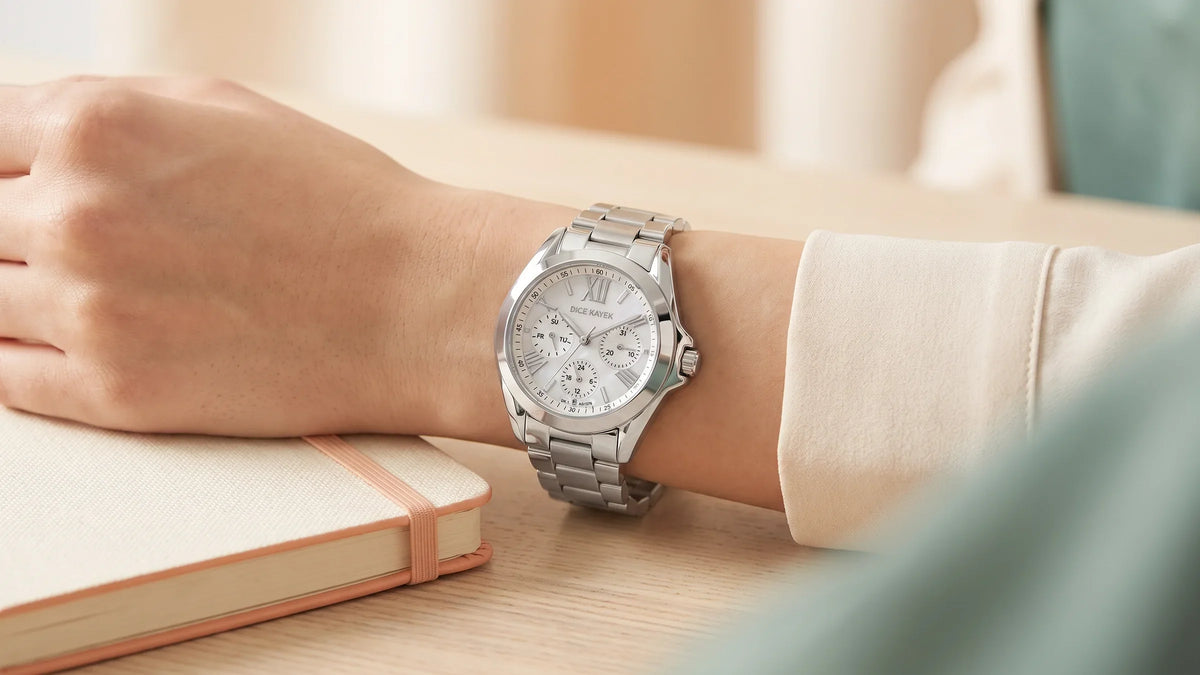
Short answer: No. Multifunction watches also have sub-dials, but these do not measure time; they show the day of the week, the date and a 24-hour indicator and move on by themselves with the time. These watches have no start-stop pushers; settings are made with the crown.
The Dice Kayek Timepieces collection has no chronograph models; on its multifunction models, for example the AG1376 and AG1358 series, the sub-dials show the day, date and 24-hour time. You can check what a model’s sub-dials show in the technical specifications and photos on its product page. A selection of multifunction models with day, date and 24-hour indicators:
All models are on the multifunction women’s watches page.
Are chronographs common in women’s watches?
Short answer: Chronographs are less common in women’s watches than in men’s. Chronograph pushers and sub-dials make the case thicker and larger, so women’s watches aiming for an elegant, slim case often prefer date or multifunction indicators. Chronographs are seen more often in sports and everyday women’s models.
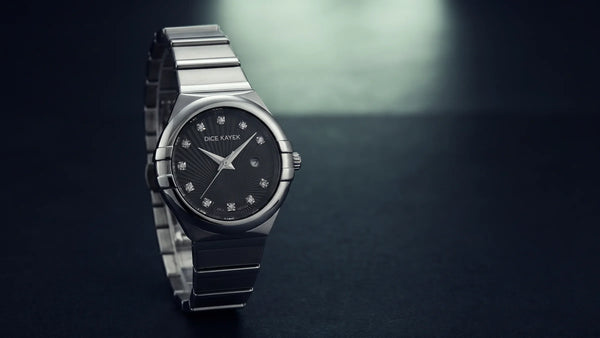
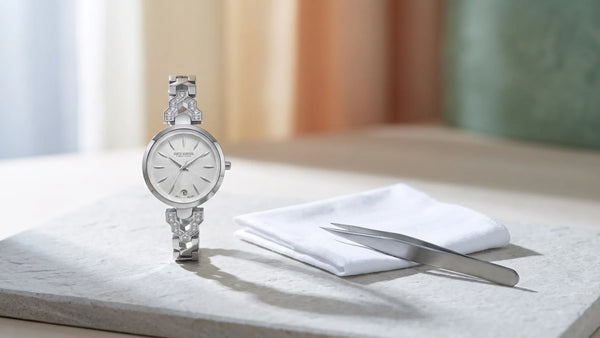
In daily life, the extra information most often needed is the date. A selection of date models with a date window and a clean dial:
All models are on the women’s date watches page.
Multifunction
Day, date and 24-hour time on one dial
Explore multifunction women’s watches whose sub-dials show the day, date and time at a glance.
Multifunction watchesFrequently asked questions
How do you use a chronograph watch?
Press the pusher above the crown to start the stopwatch, press it again to stop and reset with the pusher below the crown. Read the time from the large seconds hand and the minute and hour sub-dials; always stop before resetting.
How do you use a stopwatch?
On a wristwatch, the stopwatch, that is the chronograph, is started and stopped with the upper pusher and reset with the lower one. On digital stopwatches, MODE switches to the stopwatch screen, START/STOP times and RESET clears.
Is a chronometer the same as a chronograph?
No. A chronograph is a timing function added to a watch; a chronometer is a certified watch that has passed an accuracy test by a body such as COSC. They are confused because the Turkish word “kronometre” also means stopwatch.
What are chronograph sub-dials for?
Sub-dials count the minutes and hours of the time being measured. The continuously running small seconds dial shows that the watch is running, not the stopwatch; the layout varies by calibre.
Does starting and stopping a chronograph drain the battery?
Starting and stopping does not drain the battery, but leaving a quartz chronograph running for a long time shortens battery life because of the extra motor movement. It is best to run the chronograph only while timing.
How do you set the time on a chronograph watch?
On an analogue chronograph, the time and date are set with the crown; the pushers only control the stopwatch. On digital models, MODE switches to the time-setting screen, the adjust button is held and the flashing values are changed.
Can you press chronograph pushers under water?
No. Pressing a pusher under water can open the seals and let water into the watch. Pushers suitable for use under water exist only on dive models where the manufacturer clearly states it.
What should you do if a chronograph will not reset?
First make sure the stopwatch is stopped; on most models the reset pusher does not work while it is running. If the hand does not return to zero, use the zero-setting mode in the manual or take the watch to an authorised service centre.
How does an alarm chronograph work?
On alarm-chrono watches, the alarm and the stopwatch are separate modes. MODE switches to the alarm screen to set the time, while on the stopwatch screen START/STOP and RESET measure time; the button order varies by model.
Are chronographs common in women’s watches?
Chronographs are less common in women’s watches because the pushers and sub-dials make the case thicker. Elegant women’s watches more often use a date or multifunction dial showing the day, date and 24-hour time.
Why doesn’t the chronograph seconds hand return to zero?
A knock, a battery change or pressing reset while the stopwatch is running can shift the hand’s alignment. Many quartz chronographs have a zero-setting mode using the crown and pushers; without a manual, ask a service centre.
About this article
Written by: Dice Kayek Timepieces · Last updated: 4 November 2026
General information on chronographs, chronometers and tachymeters is based on the sources below. Pusher positions, sub-dial layout and zero setting vary by model; use your own watch’s manual as the reference. The Dice Kayek Timepieces collection has no chronograph models.
Sources: