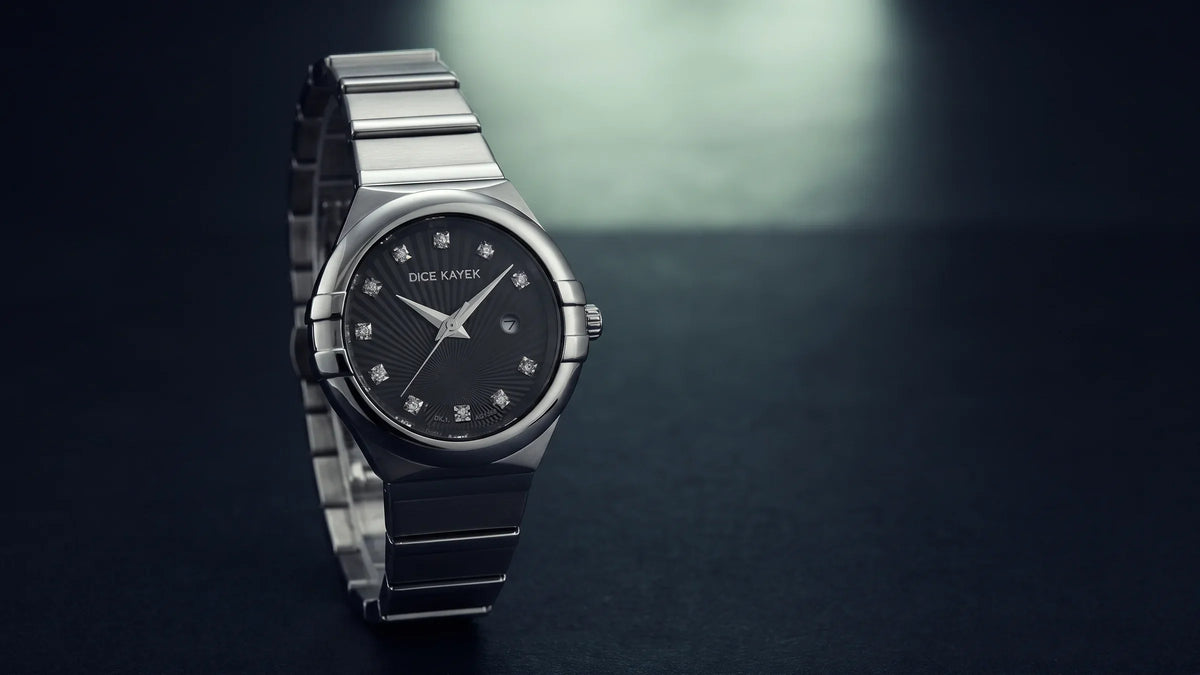
Short answer: A luminous watch is a watch whose hands, indices or dial are coated with a material that glows in the dark. Today most luminous watches use non-radioactive strontium aluminate pigments such as Super-LumiNova, which store light and give it back in the dark. These paints recharge whenever they are exposed to light and give a glow that gradually fades over several hours. Tritium tubes are a separate technology that glows by itself, without needing light. In other words, today’s luminous watch is not radioactive.
This guide explains how a luminous watch works, the difference between Super-LumiNova and tritium, how long the glow lasts, the history of old radium dials and how common luminous details are in women’s watches.
Summary in 30 seconds
- A luminous watch can be read in the dark thanks to glowing paint or tubes.
- Today’s common material is Super-LumiNova: non-radioactive and charged by light.
- Charged luminous paint glows in the dark for several hours; the glow fades over time.
- Tritium tubes glow for years without light, but contain a mildly radioactive gas.
- The radium paints of the early 20th century were abandoned because of health problems.
What is a luminous watch?
Short answer: A luminous watch is a wristwatch with a glowing material that lets you read the time in the dark. The material is usually on the hour and minute hands, the hour indices, the numerals and sometimes the rotating bezel of a dive watch. In watchmaking this material is simply called “lume”.
In everyday Turkish, the word “fosforlu” (phosphorescent) is used for anything that glows in the dark, yet the material used in watches is not the element phosphorus but phosphorescent pigments that store light and release it. A watch glows only where the luminous paint has been applied. The names of the indices and other dial parts are explained in the guide what is a watch dial.
How does a luminous watch work?
Short answer: A luminous watch works because the pigment stores light energy and slowly releases it in the dark. Daylight, a lamp or UV light lifts electrons in the pigment to a higher energy level; when the light is removed, the electrons slowly return to their original level and emit visible light as they do. The process can be repeated endlessly.
- Charging: the watch spends some time in daylight, under a lamp or in UV light.
- Storing: the pigment holds the light energy in its crystal structure.
- Glowing: in the dark the energy is released as visible light; the first minutes are the brightest.
- Fading: the glow weakens gradually over hours.
- Recharging: when the watch sees light again, the cycle starts over.
That is why a luminous watch that has spent the day in a closed drawer or under a long sleeve glows only faintly in the dark. Holding it in bright light for a short while noticeably boosts the glow.
What is Super-LumiNova?
Short answer: Super-LumiNova is a brand of strontium aluminate–based, non-radioactive and non-toxic luminous pigment used on watch dials, hands and bezels. It is based on the LumiNova pigment developed in 1993 by the Japanese company Nemoto, and it is made in Switzerland by a joint venture set up with RC Tritec.
Strontium aluminate is about 10 times brighter and glows about 10 times longer than the copper-activated zinc sulphide used before it. Super-LumiNova comes in grades such as Standard, A and X1, and the colour also affects the glow. The C3 type, which looks pale yellow-green in daylight, is the brightest, while BGW9, which looks white in daylight, is the second most effective. Colourants added for other shades reduce the light the pigment can absorb and emit.
| Pigment colour | Daylight appearance | Effect in the dark |
|---|---|---|
| C3 | Pale yellow-green | Brightest type; green light |
| BGW9 | White | Second most effective; blue-green light |
| Coloured types | Matched to the dial colour | Weaker glow because of added colourant |
Are luminous watches radioactive?
Short answer: No, the vast majority of luminous watches sold today are not radioactive. Super-LumiNova and similar strontium aluminate pigments are non-radioactive materials charged by light. The idea that “luminous watches are radioactive” is a misconception left over from the radium paints used in the early 20th century.
Radium paint was invented in 1908 and used for about 40 years on watch dials, compasses and aircraft instruments. In the United States, young women who painted dials swallowed radium because they shaped their brush tips with their lips, and they became seriously ill; the episode, known as the “Radium Girls”, changed occupational health laws. Radium gave way to tritium in the 1970s and, from the mid-1990s, to non-radioactive strontium aluminate.
| Material | Period | Light source | Radioactive? |
|---|---|---|---|
| Radium paint | Early 20th century – 1970s | Self-luminous | Yes; banned in many countries |
| Tritium (paint and gas tubes) | From the 1970s | Self-luminous | Mildly radioactive (beta emission) |
| Strontium aluminate (Super-LumiNova etc.) | Mid-1990s to today | Charged by light | No |
An old vintage watch may have radium paint on its dial; opening such a dial or scraping the paint should be left to a specialist.
How long does a luminous watch glow?
Short answer: Light-charged luminous paint glows in the dark for several hours, but the glow is strongest in the first minutes and then gradually weakens. Duration depends on the type and grade of pigment, the thickness and colour of the paint and how much light the watch has received. Tritium tubes, by contrast, glow continuously without light.
Expecting luminous paint to stay equally bright “all night” is not realistic; towards morning the glow is often faint enough to be seen only by eyes adjusted to the dark. On elegant watches with slim hands, the painted area is small, so the glow is shorter and dimmer too.
What is the difference between tritium and luminous paint?
Short answer: Luminous (photoluminescent) paint is charged by light and glows while gradually fading in the dark. Tritium is a radioactive hydrogen isotope sealed inside tiny glass tubes; the electrons it emits keep the phosphor on the inner surface of the tube glowing continuously. That is why a tritium watch looks equally bright all night without any light.
| Feature | Luminous paint (Super-LumiNova) | Tritium gas tube |
|---|---|---|
| Light source | Light received beforehand | Decay of tritium in the tube |
| Needs charging | Yes | No |
| Brightness through the night | Gradually decreases | Stays constant |
| Lifespan | Theoretically unlimited charge cycles | Half-life about 12.3 years; useful life 10–20 years |
| Radioactivity | None | Mild; sealed inside a glass tube |
Tritium has a half-life of about 12.3 years; in that time its emission halves, and because the phosphor layer also ages, brightness drops even further. Tritium tubes are mostly found in military, dive and outdoor watches.
Which wristwatches are luminous?
Short answer: Luminous details are most common on dive, pilot, sports and outdoor watches, because readability in the dark is a function on these watches. For example, the international ISO 6425 standard for dive watches requires the watch to be legible from 25 cm in total darkness and to show that it is running.
There is no single answer to “what is the best luminous watch”; the right question is in which conditions the watch will be read. When choosing a model, check:
- Which parts are luminous? Only the hands, or the indices too?
- What is the material? Does the product information mention Super-LumiNova, tritium or the brand’s own pigment name?
- Is the seconds hand luminous? It shows in the dark that the watch is running.
- How large is the painted area? Wide indices glow brighter and longer.
- What is it for? For night driving, diving or camping lume is functional; on an office watch it is an aesthetic choice.
The index, numeral and hand types that luminous paint is applied to are covered in detail in the guide to dial types and parts.
Does a luminous dial glow without light?
Short answer: No, luminous paints such as Super-LumiNova do not glow without light; the light they emit in the dark is light they stored earlier. A luminous watch that has been in the dark for a long time looks dim. The only common watch technology that glows without light is the tritium tube.
Charging luminous paint does not need a powerful source; daylight, a room lamp or a phone flash gives a noticeable charge in anything from a few seconds to a few minutes. UV light charges the pigment fastest.
Does luminous paint fade over time?
Short answer: Because strontium aluminate–based luminous paints undergo no chemical change during charging and discharging, they theoretically keep their glow properties indefinitely. In practice, a weaker glow usually comes not from the paint itself but from damage to it caused by moisture, impacts or work on the dial. Old radium and tritium paints, however, really do fade with time.
To protect the luminous parts of a watch, make sure the crystal is not cracked and the seals are intact. Any work on the dial or hands should be done at an authorised service centre; service conditions are explained on the warranty and service page. Luminous paint has nothing to do with how a watch runs; how the movement that measures time works is explained in the guide what is a quartz watch.
Are there luminous women’s watches?
Short answer: Yes, there are women’s watches with luminous details, but they are mostly sports, dive and everyday models. On elegant women’s watches, the hands are slim and the indices small or stone-set, so luminous paint is either not used at all or applied to a very limited area. That is why readability in the dark usually comes after aesthetics in women’s watches.
If night readability matters to you, choose a model with wide indices, thick hands and a luminous material clearly stated in the product information; for sports use, a silicone or rubber strap is more comfortable. Strap types are compared in the guide watch strap types.
Dice Kayek Timepieces product pages do not list luminous dials or hands as a feature; this article makes no product claim. If you would like to explore women’s wristwatches, you can find every model on the women’s watches page.
Frequently asked questions
What is a luminous watch?
A luminous watch is a watch whose hands, indices or dial are coated with a material that glows in the dark. Today that material is mostly a non-radioactive, light-charged strontium aluminate pigment such as Super-LumiNova.
How does a luminous watch work?
The luminous pigment stores energy from daylight, a lamp or UV light and slowly releases it as visible light in the dark. The glow is strongest in the first minutes and weakens over hours; the cycle restarts whenever the watch sees light.
What is Super-LumiNova?
Super-LumiNova is a brand of strontium aluminate–based, non-radioactive and non-toxic luminous pigment used in watches. It is based on LumiNova, developed by Nemoto in 1993, and is made in Switzerland.
Are luminous watches radioactive?
No, the vast majority of today’s luminous watches are not radioactive. The radioactive ones used radium paints in the early 20th century; tritium tubes are mildly radioactive but sealed in glass.
Is the lume on watches harmful?
Strontium aluminate pigments such as Super-LumiNova are neither radioactive nor toxic and are harmless in normal use. Radium paint on old vintage watches is a risk, however; such dials should only be handled by a specialist.
How long does a luminous watch glow?
Light-charged luminous paint glows in the dark for several hours; the glow is strongest in the first minutes and gradually decreases. Duration depends on the pigment type, the painted area and the light used to charge it.
What is the difference between tritium and luminous paint?
Luminous paint is charged by light and gradually fades in the dark. Tritium tubes glow continuously without light; their half-life is about 12.3 years and their useful life 10–20 years.
Which wristwatches are luminous?
Luminous details are most common on dive, pilot, sports and outdoor watches. For dive watches, the ISO 6425 standard requires the watch to be legible from 25 cm in total darkness.
Does a luminous dial glow without light?
No. Luminous paint only gives back light it has stored; a watch left in the dark for a long time looks dim. The common technology that glows without light is the tritium tube.
Does luminous paint fade over time?
Strontium aluminate–based paints theoretically keep their glow properties indefinitely. A weaker glow is usually caused by damage to the paint from moisture, impacts or work on the dial.
Are there luminous women’s watches?
Yes, but luminous women’s watches are mostly sports and everyday models. On elegant women’s watches, slim hands and small indices mean luminous paint is either not used or kept very limited.
About this article
Written by: Dice Kayek Timepieces · Last updated: 4 November 2026
Information on luminous materials, history and standards is based on the sources below. This article is a general guide and makes no claim that Dice Kayek Timepieces models have luminous dials or hands. The features of each model are listed in the technical information on its product page.
Sources: