Watch strap types fall into six main groups by material: steel (link), mesh (Milanese), leather, rubber or silicone, fabric (NATO) and ceramic. If you will wear the watch every day, choose steel or mesh; for a classic, lightweight look, leather; for sport and contact with water, rubber. Only one measurement is needed to change a strap: the distance between the lugs (lug width), usually 12–18 mm on women's watches.
The dial defines a watch's character, but the strap decides whether you will wear it every day. The wrong strap leaves even the most beautiful watch in a drawer: it feels heavy, makes you sweat, catches on a cuff or wears out within six months. This guide covers strap types, the names of the parts, measuring the width, the steps for changing a strap and care, one step at a time.
In 30 seconds
- Every day: steel or mesh. Classic and light: leather. Sport and water: rubber.
- Measurement: lug width (between the lugs, in mm); 12–18 mm on women's watches.
- If the size is uncertain, a mesh bracelet: stepless adjustment.
- Changing: quick release at home, spring bar with a tool; link removal at a service centre.
- Care: steel and mesh with a brush once a month; leather kept away from water, conditioned a few times a year.
What are the types of watch strap?
Short answer: Steel, mesh, leather, rubber/silicone, fabric and ceramic. Dice Kayek watches come with two bracelet types, both in stainless steel: a solid link steel bracelet and a finely woven mesh bracelet.
Steel (metal) bracelet
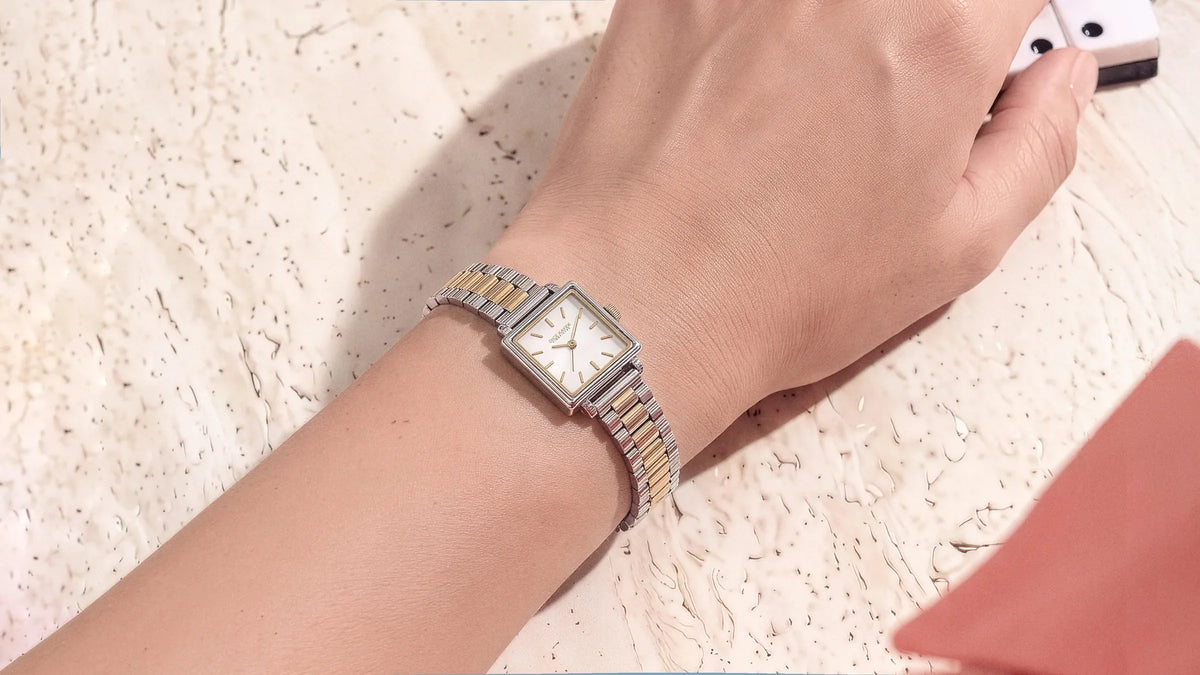
The most common choice for daily wear. Made of stainless steel; unaffected by water, sweat and sunlight, and with proper care it lasts the lifetime of the watch. Three main constructions: flat link (wide, flat links; modern and solid), Jubilee (many small links; wraps softly around the wrist, looks classic) and Oyster (three rows of wide links; sporty and durable). Mixed finishes that alternate brushed and polished surfaces play with the light. The advantages are durability, easy care and perceived value; the drawbacks are weight and resizing that requires link removal. Watches with a steel bracelet.
Mesh (Milanese) bracelet
Woven from fine steel wires; the most popular bracelet type on women's watches in recent years. Very light, flexible, stepless adjustment (you lock the clasp wherever you like), sits on the wrist like fabric; it removes the sizing uncertainty when buying a gift. Its fine weave can deform under a hard knock, and dirt that gathers between the strands calls for regular cleaning. Watches with a mesh bracelet.
Leather strap
The foundation of classic watch aesthetics; it takes the shape of the wrist over time. Calfskin is the most common and balanced option; patent leather suits formal occasions; suede and nubuck are the types most affected by water; embossed leather (crocodile or lizard pattern) is common on classic watches. The lightest option, with a warm feel; but it is affected by sweat, water, sunlight and perfume, and is replaced every 1–3 years.
Rubber and silicone strap
Designed for sport and water activities: fully water resistant, easy to clean, light. It does not look appropriate in formal settings and can attract dust over time.
Fabric and NATO strap
Woven nylon or cotton; economical, available in many colours, suited to daily and sporty wear. Because it dries slowly once wet, it is not preferred for constant contact with water.
Ceramic and special materials
High-tech ceramic bracelets are highly scratch resistant and light; they can be brittle under a hard knock and cannot be repaired.
Which strap suits you? Comparison table
| Strap | Durability | Comfort | Water resistance | Average lifespan | Best use |
|---|---|---|---|---|---|
| Steel | Very high | Medium (heavy) | Very high | 10+ years | Every day, office, daily wear |
| Mesh (Milanese) | High | Very high | High | 5–10 years | Daily wear, gifts, slim wrists |
| Leather | Medium | High (light) | Low | 1–3 years | Classic, formal, occasional |
| Rubber | High | High | Very high | 3–5 years | Sport, water, summer |
| Fabric / NATO | Medium | High | Medium | 1–2 years | Daily, sporty |
| Ceramic | Very high against scratches, low against impact | High | Very high | Long (unless broken) | Special occasions, design |
Watch strap names: a glossary of parts and terms
Short answer: The projections where the strap attaches to the case are the lugs, the connecting rod is the spring bar, the segments of a steel bracelet are links, and the closing piece is the clasp. The table below gathers the terms you will meet in service conversations and product specifications.
| Term | What it means |
|---|---|
| Lug | The projections of the case where the strap attaches; the distance between them determines the strap width. |
| Spring bar | The rod with spring-loaded ends that connects the strap to the lugs. |
| Quick release | A spring bar with a small lever on it that can be removed without tools. |
| Link | Each of the segments that make up a steel bracelet; resizing is done by removing links. |
| Jubilee / Oyster / H-link | Steel bracelet link arrangements: five rows of small links / three rows of wide links / H-shaped links. |
| Mesh / Milanese | The everyday and historical (Milan) names of the same woven bracelet. |
| Clasp | The closing piece: pin buckle (leather), fold-over clasp (steel), butterfly/deployant (a hidden clasp that opens to both sides), sliding clasp (mesh). |
| NATO / Zulu | A one-piece woven fabric strap; it passes under the watch, so the watch does not fall even if a spring bar breaks. |
| Integrated bracelet | A bracelet designed as one piece with the case; it can only be replaced with an original spare. |
How is strap width measured, and how many mm should it be?
Short answer: Measure the distance between the inner edges of the two lugs with a ruler, in millimetres; the result is usually an even number. The most common values on women's watches are 12, 14, 16 and 18 mm; on men's watches, 20 and 22 mm. In most designs the strap width is roughly half the case diameter.
- Remove the strap, or measure the point where the strap enters the case while it is fitted.
- Place the ruler between the inner edges of the two lugs.
- Read the value in millimetres. A strap of the wrong width either will not fit the case or will leave a gap and wobble.
Important: In some designs the bracelet is made as an integrated part of the case; on these models it cannot be replaced with a standard spare, only with the original bracelet of the same model. For the relationship between case diameter and wrist size, see how to choose a women's watch.
How to change a watch strap: step by step
Short answer: On quick-release straps, slide the lever; no tools needed. A standard spring bar needs a spring bar tool; a screwdriver scratches the case. On a steel bracelet, link removal is done at an authorised service centre.
On quick-release straps
- Turn the strap over; you will see a small lever on the spring bar.
- Slide the lever towards the inside of the strap with your fingernail; the bar is released.
- Remove the strap from the case.
- Seat the new strap's bar in one lug, pull the lever and let the other side drop into place; you should hear a click.
On standard spring-bar straps
- Get a spring bar tool; a screwdriver scratches the case.
- Place the forked tip of the tool between the bar and the lug.
- Compress the bar by pressing it towards the strap and gently pull the strap outwards.
- When fitting the new strap, seat one end first, then press the other end into place.
Warning: There is a high risk of scratching the case back or the lugs while changing a strap. If you have no experience, have the work done at an authorised service centre.
How is a steel bracelet resized?
On link steel bracelets, resizing is done by removing the pins inside the links; the inner face of the links carries arrow marks showing the direction of removal. An equal number of links should be removed from each side of the bracelet; otherwise the clasp will not sit centred on the wrist. On Dice Kayek watches this work is done at an authorised service centre; unauthorised intervention voids the warranty: warranty and service. For the right tightness, the "one finger" rule: which wrist should a watch be worn on.
How to care for a strap
Steel and mesh bracelets
- Clean once a month with a soft toothbrush and warm soapy water; then dry thoroughly.
- Dirt that gathers between the links and the weave has an abrasive effect over time.
- Rinse with fresh water after sea water or a pool; chlorine and salt dull the plating.
Leather straps
- Avoid contact with water; if it gets wet, dry it in the shade, not against a radiator.
- Keep perfume and cream away from the strap.
- Condition with a leather care cream a few times a year.
- It wears faster in summer because of sweat; using a spare steel or mesh bracelet for the summer protects the leather.
General care habits: watch care guide.
When should a strap be replaced?
- Leather: when cracking, stiffening, a persistent odour or tearing around the holes begins.
- Steel/mesh: when a link or the clasp develops play, or the plating is visibly worn.
- Rubber: when it loses elasticity and the surface turns whitish.
- Any strap: if the spring bar or clasp mechanism has loosened; this is the most common reason a watch falls off the wrist and it should be replaced immediately.
Featured models by strap type
The strips below read stock levels live; sold-out models do not appear in the list.
Models with a steel bracelet
Models with a mesh (Milanese) bracelet
Choose by strap
Filter the collection by strap type
Compare models suited to daily wear across steel and mesh bracelet options. Steel bracelets are resized at an authorised service centre; mesh bracelets are adjusted at home.
Watches by strap →Strap, jewellery and season
- Matching jewellery with a metal bracelet. The bracelet plating should belong to the same metal family as your rings and bracelets: ring size and matching a watch with jewellery.
- Strap by season. In summer, mesh or steel because of sweat; in winter, a slim-profile mesh bracelet sits comfortably under a thick cuff; a leather strap is the option that wears most at both extremes. Details for winter: which watch to wear in winter.
- Straps and gifts. If the size is unknown, mesh; details in what to consider when giving a woman a watch.
Frequently asked questions
Is a leather strap or a steel bracelet better?
For a watch worn every day, a steel or mesh bracelet is recommended; it is unaffected by water, sweat and sunlight and, with proper care, lasts 10 years or more. A leather strap is lighter and offers a classic look, but needs replacing every 1–3 years depending on how often it is worn.
How is watch strap width measured, and how many mm should it be?
Measure the distance in millimetres between the inner edges of the two lugs where the strap attaches to the case; this is called the lug width. The most common values on women's watches are 12, 14, 16 and 18 mm; on men's watches, 20 and 22 mm. In most designs the strap width is roughly half the case diameter.
What are the names of watch strap types?
By material: steel (link), mesh (Milanese), leather, rubber/silicone, fabric (NATO) and ceramic; by construction: flat link, Jubilee (multi-piece), Oyster (three-row) and H-link; by component: link, clasp (fold-over, butterfly, deployant), lug, spring bar and quick-release spring bar are the most common names.
Can a watch strap be changed at home?
On quick-release straps, sliding the small lever on the spring bar releases it without any tools. Standard spring-bar straps need a spring bar tool; using a screwdriver scratches the case. If you have no experience, it is safer to have an authorised service centre do it.
What is the advantage of a mesh (Milanese) bracelet?
A mesh bracelet is very light, sits on the wrist like fabric and, because its clasp can be locked at any point, offers stepless adjustment. This largely removes the sizing risk when buying a gift without knowing the wrist size.
How is a steel bracelet shortened?
It is shortened by removing the pins inside the links; the arrow marks on the inner face of the links show the direction of removal. An equal number of links should be removed from each side of the bracelet so that the clasp stays centred on the wrist. The work is best done by an authorised service centre; unauthorised intervention may void the warranty.
Does changing the strap affect water resistance?
Changing the strap alone does not affect water resistance, because the gaskets sit at the case back and around the crown. However, if the case back needs to be opened during the process, the gaskets should be checked and, if necessary, replaced.
About this article
Prepared by: Dice Kayek Timepieces Editorial Team · Editorial review: Dice Kayek product and customer experience team · Last updated: 22 September 2026
The technical information in this guide (strap types, lug measurements, changing and care steps) is based on Dice Kayek Timepieces product specifications and widely accepted standards in watchmaking. Prices and stock levels are read live in the product strips.
Related guides: Watches by strap · Watch size guide · Watch care guide · Warranty and service
Questions & suggestions: You can write to our customer service team.