How do you choose a women's watch? Start by measuring your wrist circumference; a 24–28 mm case diameter sits in proportion on a 13–15 cm wrist, 28–32 mm on a 15–17 cm wrist and 32–36 mm on a 17–19 cm wrist. Then choose the case shape, plating colour, strap and movement according to your daily use. Water resistance and crystal type determine how long the watch will last.
Almost the only reason a watch is admired in a photograph and disappoints on the wrist is proportion. This guide takes the choice out of the realm of emotion and reduces it to ten measurable criteria; under each heading you will find the short answer first, then the detail. At the end there are model suggestions by wrist size and a set of frequently asked questions.
In 30 seconds
- Measure your wrist (with a tape measure or a 1 cm strip of paper).
- A 24–28 mm case for a 13–15 cm wrist, 28–32 mm for 15–17 cm, 32–36 mm for 17–19 cm.
- Angular cases look larger than round ones at the same millimetre; if you are on the border, choose the smaller size.
- For everyday wear, a steel or mesh bracelet; for maintenance-free accuracy, a quartz movement.
- Read the label: 3 ATM covers rain and hand washing, 5 ATM showers and splashes. The crystal should be at least hardened mineral.
What is the first step in choosing a women's watch: how do you measure your wrist?
Short answer: Measure the narrowest point of your wrist, just above the wrist bone, neither tight nor loose. The centimetre value you get is the basis of every decision, from case diameter to strap length.
- If you have a tailor's tape, wrap it around the narrowest point of your wrist and read the value.
- If you do not have a tape, cut a strip of paper 1 cm wide, wrap it around your wrist, mark where it overlaps and measure it with a ruler.
- Hold the strip the way the watch will sit; if you pull it tight you will slip down a size, and if you leave it loose you will go up one.
- Take the measurement in the afternoon. The wrist swells slightly during the day; an evening measurement reflects real wear more accurately.
A second way to check: draw the case diameter of the model you like on paper with a ruler, cut it out and hold it against your wrist. This is the quickest way to see how much space a watch that looks large on screen actually takes up. Once you have your measurement, you can apply it directly with the Dice Kayek watch size guide.
How many mm should a women's watch be? Case diameter table by wrist size
Short answer: The most common range for women's watches is 26–34 mm. For a 15–17 cm wrist, 28–32 mm is the most balanced choice; 24–28 mm keeps the proportion on a slim wrist and 32–36 mm on a wider one.
| Wrist circumference | Recommended case diameter | Effect on the wrist | Collection |
|---|---|---|---|
| 13 – 15 cm | 24 – 28 mm | Worn like jewellery; delicate, classic | Small-dial watches (≤28 mm) |
| 15 – 17 cm | 28 – 32 mm | The widest range of use; balanced | Mid-dial watches (29–32 mm) |
| 17 – 19 cm | 32 – 36 mm | Modern, distinct, easy to read | Large-dial watches (33 mm+) |
Case diameter is the measurement at the widest point of the case and does not include the crown; dial diameter is the visible surface beneath the crystal and is always smaller than the case diameter. The value given on product pages is the case diameter. Across the Dice Kayek collections, case diameters range from 18 mm to 38 mm; most of this range, drawn for the female wrist, falls within the 26–34 mm band.
In practice: If your measurement falls on the border between two ranges, choose the smaller one. On a women's watch, a case that is too large looks "wrong" far more quickly than one that is too small. The same 30 mm case reads a size larger with a slim bezel and a size smaller with a thick one, so look at the bezel width in the product photograph as well.
How does the case shape sit on the wrist: round, square or rectangular?
Short answer: A round case suits every wrist and is the most predictable shape. Square and rectangular cases look larger than round ones at the same millimetre; on a slim wrist, consider going down a size. Oval and cushion shapes stretch along the wrist, so they sit comfortably on slim wrists too.
- Round — the softest and most timeless shape; the size table applies directly.
- Square — architectural and graphic. Because the corners enlarge the visual area, a 28 mm square looks like a 30 mm round.
- Rectangular — makes the wrist look longer; offers a classic, elegant presence.
- Oval and cushion case — combine the softness of a round case with the character of an angular one.
- Octagonal — distinct and modern; balanced with a smaller size on a slim wrist.
The choice of shape is a matter of personal taste; the choice of size is not. Decide on the shape first, then consult the table, going down one size for angular shapes.
Why does case thickness matter?
Short answer: Slim cases of 7–9 mm pass comfortably under a shirt or jacket cuff; cases over 10 mm catch on the cuff and make themselves felt all day. If you work at a desk, treat thickness as a criterion equal to diameter.
Thickness is directly related to the movement: quartz movements allow for slim cases, while automatic movements require a thicker one. This is the main technical reason quartz is so common in women's watches. If thickness is not given on the product page, look at the side profile photograph; the height at the point where the case meets the strap is a good indicator.
Gold, rose gold, silver: how do you choose the plating colour?
Short answer: Gold and rose gold look more natural on warm-undertone skin, silver and steel on cool-undertone skin. If you are not sure, go by the colour of the jewellery you wear every day; a two-tone watch works with both families.
- Warm undertone (the veins on the inside of the wrist look greenish) — gold and rose gold plating sits close to the skin.
- Cool undertone (the veins look bluish) — silver and steel tones read more clearly.
- Neutral undertone — both work; two-tone models are the most flexible choice.
In practice: The skin-tone rule is flexible; the consistency rule is not. Choose a plating from the same metal family as the rings and bracelets you wear all the time; if you are going to mix two metals, do it deliberately with a two-tone watch. For gold-tone watches, we explain the difference between solid gold, gold plating and gold-coloured steel in detail in the gold watch models guide.
Dial colour: legibility or character?
Short answer: For a first and only watch, a white, mother-of-pearl or silver dial is the safest choice; it is legible in every light and works with every metal. Coloured dials such as green, blue and burgundy add character and work better as a second watch.
- White, mother-of-pearl and silver — the highest legibility. Mother-of-pearl shifts in tone with the light and gives a jewellery-like effect.
- Black — sharp and formal; strong for evening wear.
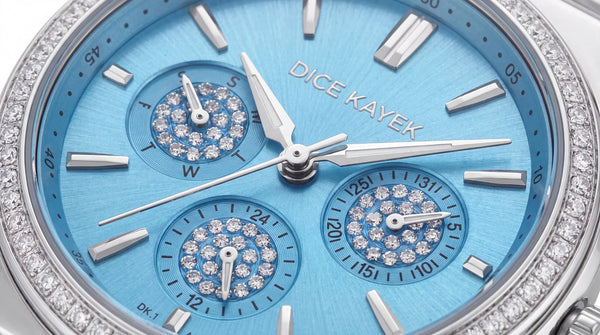
- Green, blue, turquoise, burgundy — colours that add character; sunray-brushed surfaces gain depth in the light.
- Champagne and gold, rose — soft and warm; with plating in the same colour they create a unified look.
Leather, steel or mesh? How do you choose the strap?
Short answer: For a watch worn every day, a steel or mesh bracelet; it is unaffected by water, perspiration and sunlight and lasts for years. A leather strap is the lightest and most classic option, but it needs replacing every 1–3 years depending on how often it is worn.
| Strap | Strength | Weakness | Sizing | Suited to |
|---|---|---|---|---|
| Solid steel | Durable, unaffected by water, lasts for years | Heavier; links need removing | By link, at a service centre | Everyday wearers |
| Mesh | Light, flexible, elegant | Fine weave is more sensitive to knocks | Stepless, sliding clasp | Those who want lightness and elegance |
| Leather | Lightest, warm texture, classic look | Affected by perspiration, water and sunlight; replaced every 1–3 years | Buckle holes | Occasional wearers, classic style |
| Silicone / rubber | Fully resistant to water and perspiration, very light | Sporty look; not suited to formal wear | Buckle holes | Sport and holiday wear |
In most designs the strap width is roughly half the case diameter; on a 30 mm case, a 14–16 mm strap sits in proportion. Dice Kayek watches come with two bracelet styles, both in stainless steel: a solid-link steel bracelet and a mesh bracelet. For a comparison of all strap types and the steps for changing them, see the watch strap types guide.
Quartz or automatic? Choosing the movement in a women's watch
Short answer: If you want everyday wear, a slim case and zero maintenance, quartz; if you value craftsmanship and running without a battery, automatic. The great majority of women's watches are quartz because an automatic movement requires a thicker case.
| Criterion | Quartz (battery) | Automatic (mechanical) |
|---|---|---|
| Accuracy | ±15–20 seconds a month | A few seconds a day |
| Case thickness | Slim (6–9 mm possible) | Thicker (10 mm+) |
| Maintenance | Battery change every 2–4 years | Service every 4–6 years; stops if not worn |
| Seconds hand | Ticks once a second | Sweeps smoothly |
| Suited to | Everyday wearers who want no maintenance | Those who value watchmaking tradition |
We explain how quartz works and its advantages in the what is a quartz watch article, and the signs that the battery is running down in the how long does a watch battery last guide.
What do the water resistance ratings mean?
Short answer: 3 ATM means rain and hand washing, 5 ATM showers and splashes, 10 ATM swimming. The words "water resistant" do not mean absolute protection; hot water and steam strain the gaskets at every rating.
| Rating | Suitable for | Not suitable for |
|---|---|---|
| 3 ATM (30 m) | Rain, hand washing, perspiration | Showering, swimming |
| 5 ATM (50 m) | Showering, splashes, brief contact with water | Swimming, sauna, hammam |
| 10 ATM (100 m) | Swimming, snorkelling | Scuba diving |
Dice Kayek models are rated 3 ATM or 5 ATM; the rating for each product is given on its own page. Water resistance depends on the gaskets, and gaskets tire over time: if the gasket was not renewed at the last battery change, the rating on the label no longer holds. Watches exposed to water beyond their stated rating fall outside the warranty; for details, see the watch care guide.
Mineral crystal or sapphire crystal?
Short answer: For everyday wear, hardened mineral crystal is the most balanced choice: it resists scratches well and knocks very well. Sapphire crystal is the most scratch-resistant of all, but it is more prone to cracking under a hard knock and raises the price.
- Mineral crystal: economical, resistant to knocks, moderately resistant to scratches.
- Hardened mineral crystal: surface hardness increased by heat treatment; makes a noticeable difference in everyday wear. Standard on Dice Kayek watches.
- Sapphire crystal: a hardness of 9 on the Mohs scale; keys and table edges will not scratch it, but it can crack under a sharp knock.
Which watch for which use? Office, everyday and evening
Short answer: For the office, a slim case and a neutral dial; for everyday wear, a steel bracelet and a durable crystal; for evening events, a crystal-set or mother-of-pearl dial. If you are buying a single watch, a mid-size model with a steel bracelet and a light dial covers all three.
| Use | Priority | Recommended features | Where to start |
|---|---|---|---|
| Office and work | A slim case that passes under the cuff | 28–32 mm, white/mother-of-pearl/silver dial, Roman numerals or plain indices | Romana, Pura |
| Everyday wear | Durability | Solid steel bracelet, hardened crystal, a date option | Steel bracelet, with date |
| Special occasions and evenings | Light and detail | Crystal-set dial, mother-of-pearl surface, mesh or slim bracelet | Lumina, crystal-set watches |
| Colour and character | Dial colour | Green, blue, turquoise or burgundy dial; two-tone case | Bloom, Duo |
For a more detailed breakdown by style archetype, see the women's watch models style guide, and for this year's directions, the 2026 women's watch trends.
Model suggestions by wrist size
The strips below read stock levels live; sold-out models do not appear in the list. Prices are current values.
For slim wrists (13–15 cm): 28 mm and under
For medium wrists (15–17 cm): 29–32 mm
For wider wrists (17–19 cm): 33 mm and over
Filtered search
Filter by your own criteria
With the case colour, dial colour, case shape and dial diameter filters, you can apply the criteria in this guide directly to the collection. A solid stainless steel case, hardened mineral crystal and a quartz movement are standard on every model.
Explore women's watches →How do you verify the size when buying a watch online?
Short answer: Draw the case diameter from the product page on paper and hold it against your wrist, read how sizing is done for the strap type and check the return conditions. At Dice Kayek, shipping within Türkiye is free and returns are accepted within 30 days of delivery without the need to give a reason.
- Case diameter and strap type are given on the product page; use the side profile image for thickness.
- On steel bracelets, links are removed at an authorised service centre; on a mesh bracelet, the clasp slides and can be adjusted at home.
- The watch should sit on the wrist with a finger's width of room; it should neither slide nor leave a mark.
- If you cannot decide, write to us with your wrist measurement and the models you like, and the team will make a suggestion: contact. Return and exchange conditions: returns and exchanges.
For the full checklist to go through before and after buying, see the article on what to consider when choosing a women's watch; if you are buying a gift, we explain how to find out a wrist size without giving yourself away in the guide to giving a woman a watch.
How do you pair a watch with rings and bracelets?
- Metal consistency. Keep the watch, rings and bracelet in the same metal family, or set up a deliberate contrast. For choosing a ring, see the how to measure ring size guide.
- Balance of weight. If you wear a chunky bracelet, keep the watch plain; if you wear a crystal-set watch, leave the other wrist bare.
- Which wrist. A watch is traditionally worn on the non-dominant wrist; the right wrist is not wrong either. Details: which wrist should a watch be worn on.
After the purchase: first-week checklist
- Have the strap sized; the watch should sit with a finger's width of room on the wrist.
- Keep the warranty certificate and the invoice. Dice Kayek watches carry a 2-year warranty against manufacturing defects: warranty and service.
- Apply perfume and hairspray before putting the watch on; chemicals wear down the plating and the gasket.
- Wipe the watch with a soft, dry cloth; clean between the links of a steel bracelet with a soft brush.
- When not in use, store it in its box, away from moisture and magnetic surfaces (speakers, tablet covers).
Frequently asked questions
How many mm should a women's watch be?
For a wrist circumference of 13–15 cm, a case diameter of 24–28 mm sits in proportion; for 15–17 cm, 28–32 mm; for 17–19 cm, 32–36 mm. The most common range for women's watches is 26–34 mm. If your measurement falls on the border between two ranges, choose the smaller one.
How do I measure my wrist at home?
Cut a strip of paper 1 cm wide, wrap it around the narrowest point of your wrist, neither tight nor loose, mark where it overlaps and measure it with a ruler. If you have a tailor's tape, measure directly at the same point. Measuring in the afternoon gives a more realistic result.
Which watch suits a slim wrist?
On a 13–15 cm wrist, a 24–28 mm case, a slim bezel and a mesh bracelet or a fine-link steel bracelet give the most balanced result. Square and rectangular shapes look larger at the same millimetre, so a round or oval case is the safer choice on a slim wrist.
What is the difference between case diameter and dial diameter?
Case diameter is the widest measurement of the case, excluding the crown, and is the value given on product pages. Dial diameter is the visible surface beneath the crystal and is always smaller than the case diameter. At the same case diameter, a model with a slim bezel looks larger.
Leather strap or steel bracelet: which is better?
For a watch worn every day, a steel or mesh bracelet is recommended; it is unaffected by water, perspiration and sunlight and lasts for years. A leather strap is lighter and offers a more classic look, but it needs replacing every 1–3 years depending on how often it is worn.
Quartz or automatic: which is better for a women's watch?
Quartz movements are more common in women's watches because automatic movements require a thicker case, which upsets the proportion on a slim wrist. A quartz movement runs with a deviation of 15–20 seconds a month, needs no maintenance and only asks for a battery change every 2–4 years.
Can I shower with a 3 ATM water-resistant watch?
No. 3 ATM (30 metres) is sufficient for rain, hand washing and perspiration; showering calls for 5 ATM and swimming for 10 ATM. Hot water and steam strain the gaskets at every rating, so the watch should be removed in the shower, sauna and hammam.
How do I choose a watch to suit my skin tone?
On warm-undertone skin, where the veins look greenish, gold and rose gold plating sits more harmoniously; on cool-undertone skin, where the veins look bluish, silver and steel tones work better. With a neutral undertone both work, and in that case two-tone models are the most flexible choice.
About this article
Prepared by: Dice Kayek Timepieces Editorial Team · Editorial review: Dice Kayek product and customer experience team · Last updated: 22 September 2026
The technical information in this guide (case sizes, movement, water resistance, crystal and strap types) is based on Dice Kayek Timepieces product specifications and widely accepted standards in watchmaking. The ranges in the size table are recommendations; personal preference and case shape may change the outcome. Price and stock information is read live.
Related guides: Watch size guide · Watches by case diameter · Watch care guide · Warranty and service
Questions & suggestions: You can write to our customer service team.