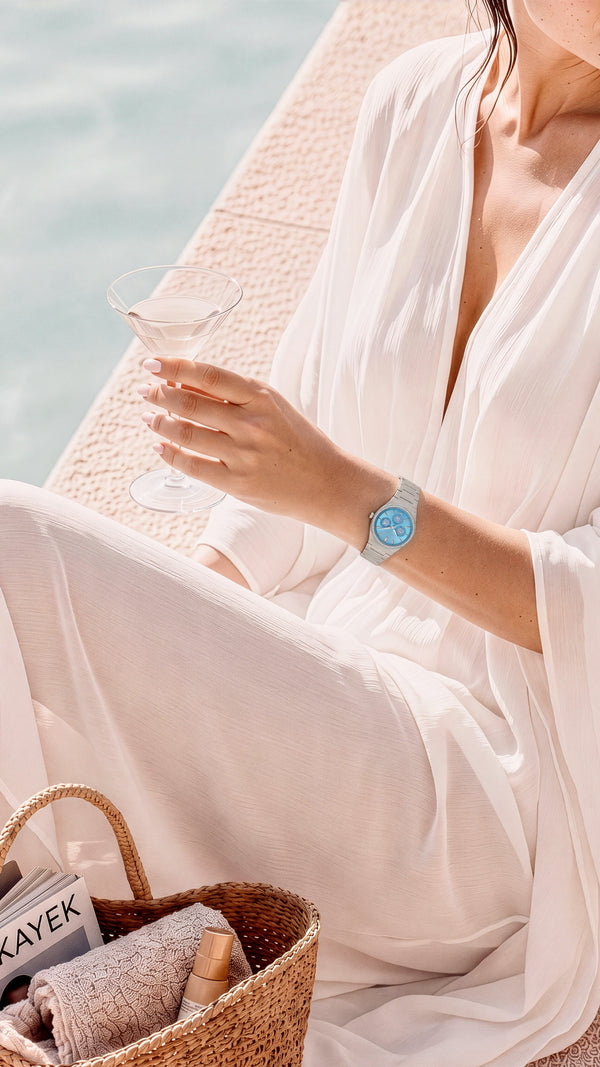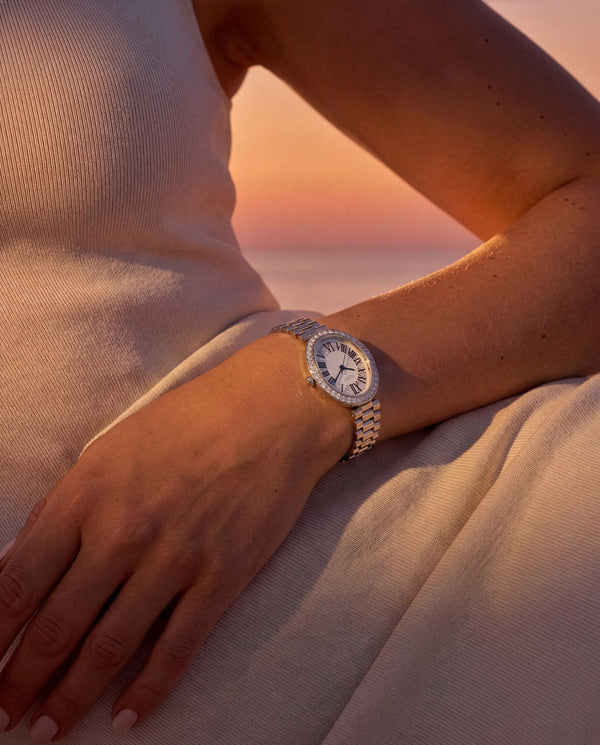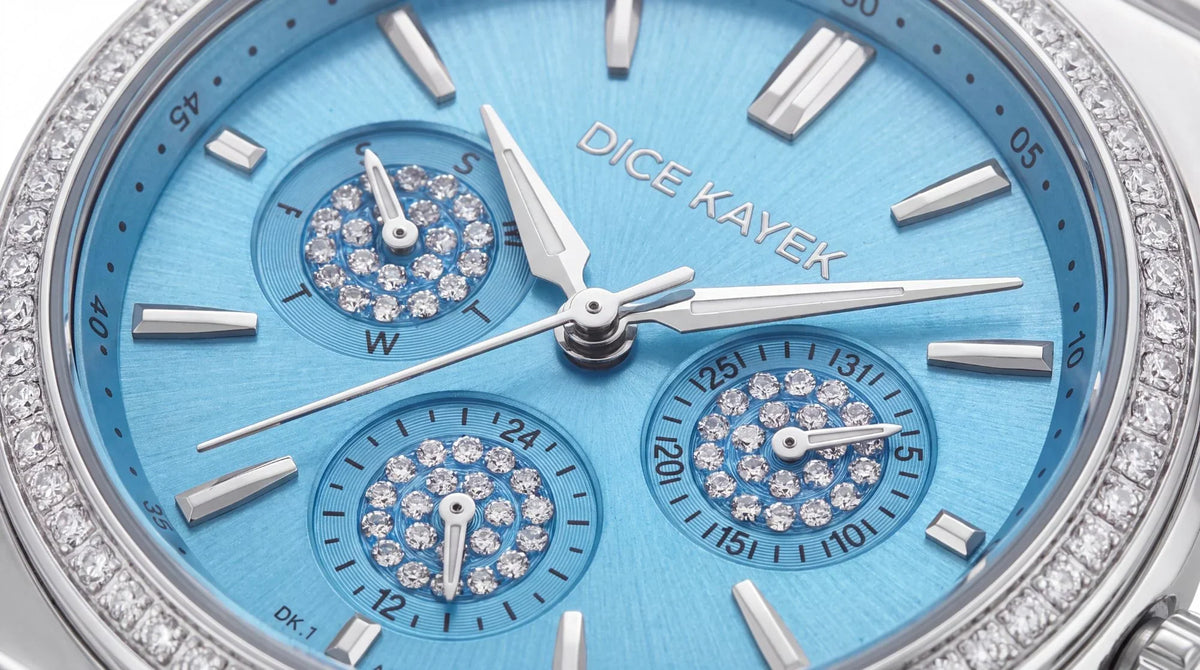
Six directions stand out in women's watch models for 2026: the return of the small case (28 mm and under), square and rectangular angular shapes, coloured dials led by green, the comeback of two-tone plating, crystal detail moving into everyday wear, and the lightness that comes with the mesh bracelet. The end of the large-case era and a return to shape is the main story of the year.
Watch trends work differently from fashion trends: they are cyclical, not seasonal. A shape or a size returns once a decade and, when it does, it stays for a long time. This guide looks at the six directions taking shape in 2026 and pairs each reading with concrete shares drawn from the Dice Kayek collection's own catalogue analysis. The broader trends highlighted by industry publications are covered in a separate section.
The six directions of 2026
- The return of the small case (28 mm and under)
- The rise of angular shapes (square and rectangular)
- Coloured dials, green first
- Two-tone plating (gold and steel together)
- Crystal detail moving into everyday wear
- Mesh bracelets and the priority on lightness
A look at the data: what does the collection say?
Short answer: In the August 2026 catalogue analysis, the distribution of all models in stock was compared with the distribution of the 74 newly arrived models. If a category's share of the new season is higher than its share of the overall collection, that category is on the rise: small dials, angular shapes, crystal detail and two-tone plating are rising; large dials are declining.
| Category | Share of overall collection | Share of new season | Direction |
|---|---|---|---|
| Small dial (28 mm and under) | 53% | 77% | ▲ Marked rise |
| Square + rectangular case | 18% | 45% | ▲ Marked rise |
| Crystal-set models | 10% | 24% | ▲ Rising |
| Two-tone plating | 13% | 22% | ▲ Rising |
| Green dial | 23% | 27% | ▲ Slight rise |
| Large dial (33 mm and over) | 16% | 9% | ▼ Declining |
Note: The data is based on the August 2026 catalogue analysis of the Dice Kayek Timepieces collection and reflects the brand's own design direction; it is not a generalisation for the whole industry.
What stands out across the industry in 2026?
Short answer: The shared emphasis of watch publications for 2026 is simplification: balanced case proportions, smaller logos, brushed surfaces, quiet tones such as beige, grey and champagne, and pastel coloured dials. This picture overlaps with the small-case and coloured-dial directions in our collection data; angular shapes and two-tone plating, on the other hand, are more pronounced in our collection than the industry average.
1. The return of the small case
Short answer: In the mid-2010s, 36–40 mm cases became common in women's watches; in 2026 the direction has reversed, and 77% of new models are 28 mm and under.
Why: The large case was a product of the era when a watch was an "accessory statement". Today the watch has become a piece layered with jewellery; a small case is far better suited to being worn alongside bracelets and slim rings. Who it suits: Those with a slim wrist, those who layer jewellery, and those looking for a classic, elegant presence. For case diameter by wrist size, see how to choose a women's watch. Small-dial models →
2. The rise of angular shapes
Short answer: The round case is still the majority; in the new season, however, the share of square and rectangular shapes rose from 18% to 45%. It is the most distinct design movement of the year.
Why: The round case is the "default", and therefore not distinctive. Angular shapes turn the watch from a time-telling instrument into an architectural object; it is the clearest contribution design-led brands have made to the watch category. Note: Angular cases look larger than round cases of the same diameter; on a slim wrist, choose one size smaller. Square · Rectangular models →
3. Coloured dials: led by green
Short answer: Neutral dials still dominate, but the coloured dial is moving from "second watch" to first choice. Green leads; turquoise, burgundy and deep blue follow.
Why: As jewellery and accessories have become more neutral, colour has moved to the wrist. On a neutral wrist, a green dial becomes the single accent. Rule: A coloured dial works when it is the second colour on the wrist; added as a third colour, it creates clutter. Green · Blue · Turquoise dial models →
4. Two-tone plating is back
Short answer: Gold and steel on the same watch, long considered "dated", has returned with force: in the new season, its share rose from 13% to 22%.
Why: Mixing metals in jewellery is no longer a broken rule but a deliberate choice. A two-tone watch visually legitimises wearing jewellery in different metals at the same time; it serves a practical purpose. For plating types, see gold watch models. Two-tone models →
5. Crystal detail moves into everyday life
Short answer: Crystal-set models were for a long time reserved for evening occasions; in the new season their share rose from 10% to 24%, and the design language has changed: instead of crystals covering the entire dial, measured crystal detail on the bezel or the indices.
Result: The same watch can be worn at the office in the morning and at an evening event; an important development for those who rely on a single watch. Crystal-set models →
6. Lightness and the mesh bracelet
Short answer: On the bracelet side, the direction is clear: a move away from weight. Mesh bracelets are growing their share with stepless length adjustment and a structure that sits like fabric; among steel bracelets, designs with smaller, more numerous links that wrap softly around the wrist stand out.
Mesh bracelet models → · Detailed comparison: watch strap types
The standout models of 2026
The strips below read stock levels live; sold-out models do not appear in the list.
Small case and angular shape
Two-tone plating and crystal detail
New season
Be the first to see the new arrivals
The new-season collection reflecting the small-case, angular-shape and coloured-dial directions. Browse by filtering on case shape, case colour and dial diameter.
Discover the new arrivals →To follow the trend, or not?
Short answer: A watch is worn for an average of 5–10 years; that is why following trends carries risk. Do not follow trends for a first watch, do follow them for a second, and stay in the middle of the trend for a gift.
- If this is your first watch, do not follow trends. A 29–32 mm round case, a neutral dial, a steel bracelet: this combination will still look right ten years from now.
- If this is your second watch, follow the trends. A coloured dial, an angular shape and crystal detail deliver the most as a second watch.
- If you are buying a gift, stay in the middle of the trend. A very new direction may not match the recipient's taste: what to consider when giving a woman a watch.
Choosing a model by style archetype: women's watch models style guide. Dial and strap suggestions for the winter season: which watch to wear in winter.
Frequently asked questions
Which trends stand out in women's watches for 2026?
Six directions are taking shape in 2026: the return of the small case (28 mm and under), the rise of square and rectangular angular shapes, coloured dials led by green, the comeback of two-tone plating, crystal detail moving into everyday wear, and the priority on lightness that comes with the mesh bracelet.
Are case sizes in women's watches getting smaller?
Yes. In the August 2026 catalogue analysis of the Dice Kayek collection, cases of 28 mm and under account for 53% of the overall collection but rise to 77% of new-season models; cases of 33 mm and over fall from 16% to 9%. The reason is that a watch is no longer a standalone accessory statement but a piece layered with jewellery.
Are square and rectangular watches in fashion?
Yes. The most distinct design movement of 2026 is the rise of angular shapes. Among new-season models, the share of square and rectangular cases rises from 18% to 45%. Angular cases look larger than round cases of the same diameter, so on a slim wrist one size smaller is the better choice.
Which dial colour is on trend in 2026?
Green leads; turquoise, burgundy and deep blue follow. A coloured dial works best when it becomes the single accent on a wrist where jewellery and accessories are neutral; it delivers the most as a second watch.
Should I follow trends when buying a watch?
A watch is worn for an average of 5–10 years, so following trends carries risk. If this is your first watch, do not follow trends: a 29–32 mm round case, a neutral dial and a steel bracelet will still look right ten years from now. If it is your second watch, a coloured dial, an angular shape and crystal detail deliver the most. If you are buying a gift, stay in the middle of the trend.
Are two-tone watches out of fashion?
No. On the contrary, they have made a strong comeback. Among new-season models, the share of two-tone plating rose from 13% to 22%. There is a practical reason: a two-tone watch makes wearing jewellery in different metals at the same time look visually consistent.
Where does the data in this article come from, and when is it updated?
The share table is based on the August 2026 catalogue analysis of the Dice Kayek Timepieces collection: the distribution of all models in stock was compared with the distribution of the 74 newly arrived models. It reflects the brand's own design direction and is not a generalisation for the whole industry. The article is updated every January with new-season data.
About this article
Prepared by: Dice Kayek Timepieces Editorial Team · Editorial review: Dice Kayek product and customer experience team · Last updated: 22 September 2026 · Data period: August 2026 catalogue analysis
The share table is based on the distribution of in-stock models in the Dice Kayek Timepieces collection and reflects the brand's own design direction. Industry-wide trends were compiled from the 2026 assessments of watch and style publications; no sales or market data was used. The article is updated every January with new-season data and the year in the title.
Related guides: Watches by case shape · Watches by dial colour · Watch size guide
Questions & suggestions: You can write to our customer service team.