Short answer: Watch case size, or case diameter, is the width of the watch case measured at its widest point, excluding the crown; in other words, the distance from the case edge at 9 o’clock to the edge at 3 o’clock, given in millimetres (mm). Case size is measured with calipers; a ruler gives an approximate value. To convert millimetres to centimetres, divide by 10: a 35 mm watch is 3.5 cm wide, a 40 mm watch 4 cm.
This guide explains where watch case size is measured, how it differs from dial diameter and lug-to-lug, how to measure it at home, an mm–cm conversion table and how to read the size on a product page.
Summary in 30 seconds
- Case size = the widest point of the case, excluding the crown, in mm.
- mm → cm: divide by 10. 35 mm = 3.5 cm; 40 mm = 4 cm.
- Dial diameter is smaller than case size; lug-to-lug is the tip-to-tip distance of the lugs.
- The most accurate measurement is made with calipers; a ruler gives an approximation.
- The exact size of each model is in the “Case diameter” line on the product page.
What is watch case size, and where is it measured?
Short answer: Watch case size is the widest distance from one edge of the case to the opposite edge, measured without the crown. When you hold the watch with the dial facing you, this measurement runs from the case edge at 9 o’clock to the case edge at 3 o’clock. Case size is given in millimetres (mm) and is the measurement that most determines how large the watch looks on the wrist.
On round cases, case size is a single value. On square, rectangular and oval cases, the size is given as a side length or as width × length; the diagonal does not count as case size. How to read the size on angular cases is explained in detail in the watch shapes guide.
What is the difference between case size, dial diameter and lug-to-lug?
Short answer: Case size, dial diameter and lug-to-lug are three different measurements. Case size is the widest point of the case; dial diameter is only the diameter of the surface under the crystal and is smaller than case size; lug-to-lug is the distance from one tip of the lugs, where the strap attaches, to the other, and shows how much length the watch takes up on the wrist.
| Measurement | From where to where? | What it tells you |
|---|---|---|
| Case size | Case edges at 9 and 3 o’clock, excluding the crown | How large the watch looks |
| Dial diameter | Edges of the surface under the crystal | How large the readable area is |
| Lug-to-lug | From the top lug tip to the bottom lug tip | How long the watch is along the wrist |
| Case thickness | From the case back to the top of the crystal | Whether it slips under a cuff |
| Lug width | The inside distance between the lugs | Which straps will fit |
Lug width is the measurement you need for changing straps; strap types and sizes are compared in the watch strap types guide.
How do you measure watch case size?
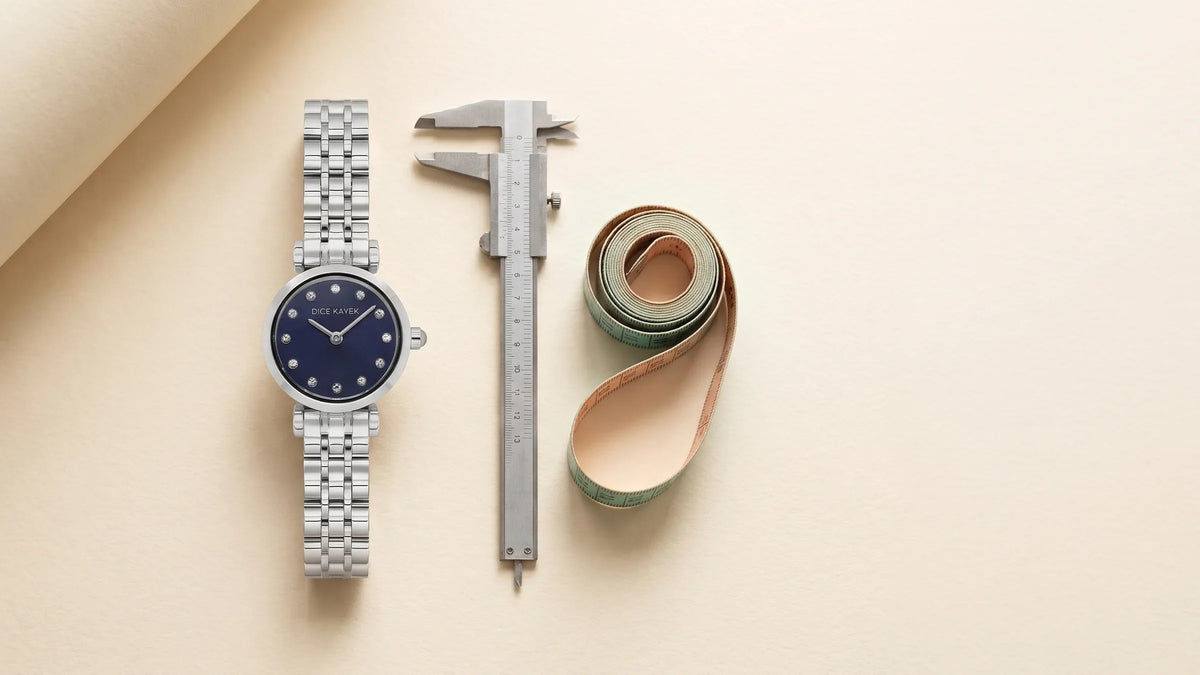
Short answer: Watch case size is measured most accurately with calipers: rest the jaws of the calipers against the case edges at 9 and 3 o’clock, leaving the crown out, and read the value on the display or scale. Without calipers you can take an approximate measurement with a ruler, but because a ruler does not show fractions of a millimetre, the result may be off by a few millimetres.
- Lay the watch on a flat surface: dial facing you, 12 at the top.
- Locate the crown: the crown is not included; start the measurement from the edge opposite the crown.
- Position the calipers: rest the jaws lightly against the case edges at 9 and 3 o’clock.
- Read the value: note the result in millimetres; divide by 10 for centimetres.
- If you use a ruler: run it across the widest point of the case and read the value at eye level.
Without calipers or a ruler, marking both edges of the watch on paper and measuring the distance afterwards also gives an approximate result.
Is the crown included in case size?
Short answer: No, under the widely accepted method in watchmaking, the crown is not included in case size. Case size is measured at the widest point of the case without the crown. Because some sellers may quote the size including the crown, checking the note in the product information is best when you want to be sure.
When the crown is included, the figure grows by a few millimetres and the watch seems larger on paper than it is. The difference is more noticeable on models with crown guards or large crowns.
How many cm is 35 mm? mm–cm conversion table
Short answer: 35 mm is 3.5 cm. To convert millimetres to centimetres, simply divide by 10: 1 cm is 10 mm. So a 30 mm watch is 3 cm wide, a 38 mm watch 3.8 cm and a 40 mm watch 4 cm. The table below shows the centimetre equivalents of sizes commonly seen on wristwatches.
| Case size (mm) | Centimetres (cm) | To picture it |
|---|---|---|
| 22 mm | 2.2 cm | Close to the width of a knuckle |
| 26 mm | 2.6 cm | Close to a coin |
| 28 mm | 2.8 cm | A little bigger than a small button |
| 30 mm | 3.0 cm | Exactly 3 cm |
| 32 mm | 3.2 cm | A medium women’s watch size |
| 34 mm | 3.4 cm | A prominent women’s watch size |
| 35 mm | 3.5 cm | Exactly 3.5 cm |
| 36 mm | 3.6 cm | A size often seen on unisex watches |
| 38 mm | 3.8 cm | The size of many classic men’s watches |
| 40 mm | 4.0 cm | Exactly 4 cm |
How a size looks on the wrist depends not only on centimetres but also on wrist width, case shape and lug-to-lug. That is why two watches with the same diameter can look different.
Is a 40 mm watch too big for a woman’s wrist?
Short answer: 40 mm, or 4 cm, is generally a large size for women’s watches and looks bold or oversized on most women’s wrists. It can suit someone with a wide wrist or who deliberately prefers a large-watch look; on a slim wrist, the ends of the case may overhang the wrist. Wrist width and lug-to-lug make the final call.
Which case size to choose for your wrist circumference is set out in a table in the how to choose a women’s watch guide. This article focuses on what the measurement is and how to read it; use that table for choosing.
What case size suits a slim wrist?
Short answer: A small or medium case size gives the most balanced result on a slim wrist; the case edges and lugs should not overhang the top of the wrist. The exact value depends on wrist circumference, so choosing with the case size by wrist size table is best.
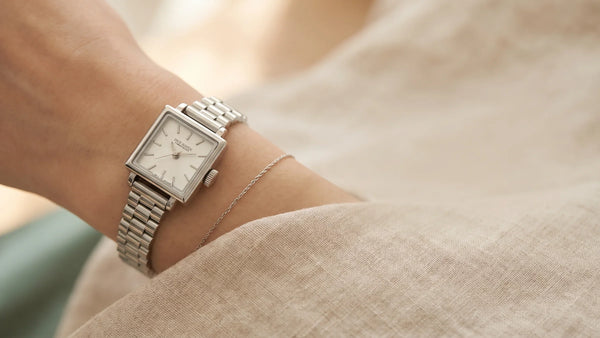
On a slim wrist, lug-to-lug matters as much as case size: a watch with short lugs looks smaller than one with long lugs at the same diameter. Because square and rectangular cases look larger than round ones at the same size, it is worth considering one size smaller on a slim wrist. A selection of small-case models:
All small-case models are on the small-case watches page.
Where can I find the case size on a product page?
Short answer: On Dice Kayek product pages, case size is listed in millimetres in the “Case diameter” line of the technical specifications below the add-to-cart button; right next to it is a “Size guide” link that helps you choose by wrist circumference. Case size is also repeated in the product description.
- Open the product page and scroll to the specifications list below the price.
- Find the “Case diameter” line: the value is in millimetres; divide by 10 for cm.
- Click “Size guide”: you will see suitable sizes for your wrist circumference.
- Check the case shape: on oval and rectangular cases the size may be given as width × length.
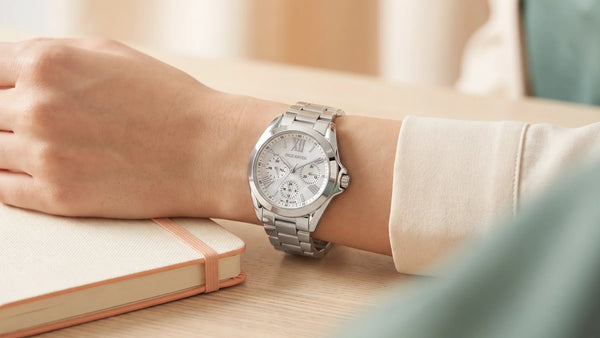
You can compare all models by case size on the watches by case size page. A selection of medium-case models:
All medium-case models are on the medium-case watches page.
How can you try a case size before buying?
Short answer: The easiest way to try a case size before buying is to picture it on your wrist: draw the millimetre value from the product page on paper, cut it out as a circle and place it on your wrist. Comparing it with a watch at home whose size you know is also a good method.
A paper template shows the case size but not the lug-to-lug or thickness, so extend the template by about a finger’s length to account for the area the lugs cover. If a model does not look the way you expected on your wrist, you can use your returns and exchanges right within 30 days of delivery (except watches engraved on the case back). A selection of large-case models:
Case size
Find the size that suits your wrist
Compare all small, medium and large-case models by case size on a single page.
Watches by case sizeFrequently asked questions
What is watch case size?
Watch case size is the widest distance from one edge of the case to the opposite edge, measured without the crown. It is given in millimetres and is the measurement that most determines how large the watch looks on the wrist.
How do you measure watch case size?
Rest the jaws of the calipers against the case edges at 9 and 3 o’clock, leaving the crown out, and read the value in millimetres. Without calipers, a ruler gives an approximate measurement.
How many cm is 35 mm?
35 mm is 3.5 cm. To convert millimetres to centimetres, divide by 10; for example 30 mm is 3 cm and 38 mm is 3.8 cm.
How many cm is 40 mm, and is it too big for a woman’s wrist?
40 mm is 4 cm and is generally a large size for women’s watches. It can suit a wide wrist or someone who likes an oversized look; on a slim wrist, the case ends may overhang the wrist.
Are case size and dial diameter the same?
No. Case size is the widest point of the case; dial diameter is only the diameter of the surface under the crystal and is smaller than case size.
Can you measure watch size with a ruler?
Yes, a ruler gives an approximate measurement. Run it across the widest point of the case and read the value at eye level; use calipers for a more precise result.
Is the crown included in case size?
Under the widely accepted method, the crown is not included in case size. Because some sellers may quote the size including the crown, it is worth checking the note in the product information.
What is lug-to-lug?
Lug-to-lug is the distance from one tip of the lugs, where the strap attaches, to the other. It shows how much length the watch takes up on the wrist and helps you see whether the case will overhang.
What case size suits a slim wrist?
A small or medium case size gives the most balanced result on a slim wrist; the case and lugs should not overhang the top of the wrist. Use a case size by wrist circumference table for the exact choice.
Where can I find the case size on a product page?
On Dice Kayek product pages, case size is listed in millimetres in the “Case diameter” line of the technical specifications; the “Size guide” link next to it helps you choose by wrist circumference.
Is a 42 mm case too big?
42 mm, or 4.2 cm, is a large size for a woman’s wrist and is mostly seen on men’s or large unisex watches. Smaller case sizes are more common on women’s watches.
About this article
Written by: Dice Kayek Timepieces · Last updated: 5 November 2026
General information on units of measurement and measuring tools is based on the sources below, and Dice Kayek product details on the store’s current product and collection pages. Case size varies by model; the exact size is in the technical specifications on each product page.
Sources: