Short answer: The main visible parts of a wristwatch are the case, case back, bezel, crystal, dial, hands, crown, lugs and strap; inside sit the movement and the gaskets. Knowing the names of watch parts makes it easier to read a product sheet, talk to a service centre and choose the right watch.
Terms such as “bezel”, “lug” and “case back” appear on product pages all the time but are rarely explained. This guide defines the parts of a watch one by one from the outside in, gathers what each part does in a single table and ends with a short glossary of wristwatch terms.
The 30-second summary
- The case is the body of the watch; it holds the movement, dial and crystal.
- The bezel is the ring around the crystal; on women’s watches it is usually fixed and decorative.
- On a quartz watch, the crown is used to set the time and date; push it fully home after every adjustment.
- The lugs are where the strap attaches; the distance between them sets the strap width.
- The dial is the face you read; its markings are indices and its pointers are hands.
What are the parts of a watch? Every name in one table
Short answer: The parts of a watch fall into two groups. The exterior parts are the case, case back, bezel, crystal, dial, indices, hands, crown, lugs, strap and clasp. The interior parts are the movement, the gaskets and, in quartz watches, the battery. The table below shows where each part sits, what it does and its common name.
| Part | What it does | Where it is | Also called |
|---|---|---|---|
| Case | The body that holds the movement, dial and crystal and protects them from the outside | The main body of the watch | Watch case |
| Case back | Closes the case from behind; opened for battery changes | The side against the wrist | Back cover |
| Bezel | The ring that holds the crystal in place and frames the dial | Around the crystal | Bezel ring |
| Crystal | Protects the dial and hands | Above the dial | Watch glass |
| Dial | The surface on which time is read | Under the crystal | Watch face |
| Index | Marks showing the hour positions (batons, dots, numerals, stones) | On the dial | Hour marker |
| Hands | Show the hour, minute and second (hour hand, minute hand, seconds hand) | Centre of the dial | Pointers |
| Crown | Sets the time and date; winds mechanical watches | Side of the case, usually at 3 o’clock | Winding crown |
| Lugs | The projections where the strap attaches to the case | Top and bottom of the case | Horns |
| Strap and clasp | Hold the watch on the wrist and close it | Attached to the lugs | Band / bracelet, buckle |
| Date window | An aperture showing the date | On the dial, usually at 3 o’clock | Date aperture |
| Movement | The internal mechanism that runs the watch (quartz, mechanical, automatic) | Inside the case | Calibre |
| Gasket | Keeps water and dust out around the case back, crown and crystal | At the joints | Seal |
These terms appear under the same names on product sheets and service forms. The strap’s own parts (spring bars, links, clasp types) are a separate topic; we summarise them briefly in the lugs section below and link to the dedicated guide.
What is a watch case and what does it include?
Short answer: A watch case is the body that holds the movement, dial and crystal and protects them from knocks, water and dust. The case also includes the bezel, case back, crown and lugs. The “case diameter” on product pages is the widest point of the case, excluding the crown.
Case shape (round, square, rectangular, oval) decides how the watch sits on the wrist; you can browse models by shape on our watches by case shape page. Case material decides durability; for everyday wear, the most common material is stainless steel.
The case back is the rear cover of the case that rests against the wrist, and it comes in four basic types:
- Snap-off: the cover pulls straight off and presses straight back on.
- Screw-down: the whole cover is rotated to open; it usually has notches around its outer edge.
- Screwed: the cover is held to the case with tiny screws.
- Unibody: there is no back cover; the movement is reached from the front.
Whatever the type, the case back should only be opened at an authorised service centre; checking the gasket when it is opened and closed is necessary to keep the water resistance. In search engines, “watch case” is also used for watch storage boxes and safes; in this guide it means the body of the watch itself.
What is a bezel and what does it do?
Short answer: The bezel is the ring that holds the watch crystal in place and frames the dial. It can be fixed or rotating. On women’s watches the bezel is usually fixed and part of the design: polished, brushed, stone-set or in a contrasting colour. A rotating bezel is a tool for tracking elapsed time.
- Fixed bezel: holds the crystal and gives the case character; a slim bezel makes the dial look larger, a thick one smaller.
- Stone-set bezel: stones set into the frame bring the watch closer to jewellery; common on evening and special-occasion watches.
- Rotating bezel: its minute scale tracks elapsed time. ISO 6425 requires divers’ watches to have a unidirectional device with a 60-minute scale; it appears on dive and sports watches.
A watch with a rotating bezel is not always a dive watch; for the distinction, see the use-type table in our types of watches guide.
What does the crown do?
Short answer: The crown is the small knob on the side of the case used to set the watch. On a quartz watch, the crown is pulled out to set the time and date; on a mechanical watch it also winds the mainspring. After setting, push the crown fully home; a half-open crown is the most common way water gets into the case.
On most quartz watches with a date, the crown has three positions: fully in for normal running, the first step for the date and the second step for the time. The number of positions varies by model; the exact use is in the instructions supplied with the watch. On some watches the crown screws down onto the case (screw-down crown); this increases water resistance and is more common on sports watches.
On a quartz watch the crown is only for setting; the watch runs on a battery, so it is never wound. For how it works, see our guide to what a quartz watch is.
What are lugs, and how do you measure lug width?
Short answer: Lugs are the projections at the top and bottom of the case where the strap attaches. The strap is fitted between two lugs with a spring bar. The distance between the inner edges of the two lugs is the lug width, and it sets the width of strap the watch can take.
Lug width is measured with a ruler, in millimetres, between the inner edges of the two lugs. Another measurement is lug-to-lug: the vertical length from the tip of the top lug to the tip of the bottom lug. Lug-to-lug shows how much room the watch takes on the wrist better than case diameter does; on a slim wrist, it should not exceed the width of the wrist.
The strap’s own parts (spring bars, links, clasp types), a strap-width table and the steps for changing a strap are covered in detail in our watch strap types guide.
Dial, indices and hands: the face of the watch
Short answer: The dial is the surface under the crystal on which time is read. The hour markings on the dial are called indices, and the rotating pointers are called hands. The short hand shows the hour, the long hand the minute, and the thin, fast-moving hand the second.
- Index types: batons, dots, Arabic numerals, Roman numerals and stone-set indices. The index type sets the watch’s character: Roman numerals read classic, batons read clean, stones give a jewellery effect.
- Date window: a small aperture on the dial that shows the date, usually at 3 o’clock.
- Dial finish: sunray (radial brushing from the centre outwards), mother-of-pearl, matt or patterned; the same colour looks different on a different finish.
The dial’s structure, materials and finishes are covered in detail in our guide to what a watch dial is.
Crystal and movement: hidden but decisive parts
Short answer: The watch crystal protects the dial and comes in three main types: acrylic, mineral and sapphire. The movement is the internal mechanism that runs the watch; in wristwatches it is quartz, mechanical or automatic. Gaskets keep water out around the case back, crown and crystal.
| Crystal type | Characteristics | Watch out for |
|---|---|---|
| Acrylic | The most economical and lightest; fine scratches can be polished out | The most prone to scratching |
| Mineral | Tempered glass; resistant to knocks, moderately resistant to scratches | The hardened version suits everyday wear |
| Sapphire | The most scratch-resistant type | Can crack under a hard knock; the most expensive option |
Covering the differences between movement types in depth is not the subject of this guide; for a short comparison, see our types of watches guide.
Glossary of wristwatch terms
Short answer: A glossary of wristwatch terms gives short explanations of the technical words used on product sheets and in service conversations. The table below gathers the terms you will meet most often for the case, dial and display; strap terms are listed separately in the strap guide.
| Term | Meaning |
|---|---|
| Case diameter | The widest measurement of the case, excluding the crown (mm) |
| Lug-to-lug | The vertical distance between the tips of the top and bottom lugs |
| Case thickness | The height from the case back to the highest point of the crystal |
| ATM | Water resistance rating; 3 ATM covers rain and hand washing, 5 ATM showers and splashes |
| Sunray dial | A dial brushed radially from the centre outwards that catches the light |
| Complication | Any indication beyond hours, minutes and seconds (date, moon phase, etc.) |
| Sub-dial | A small display area within the main dial |
| Screw-down crown | A crown that screws onto the case, increasing water resistance |
| Spring bar | A spring-loaded, double-ended pin that attaches the strap to the lugs |
| Gasket | A ring at the case joints that keeps water and dust out |
Which parts are standard on Dice Kayek watches?
Short answer: Dice Kayek Timepieces women’s watches come standard with a solid stainless steel case and bracelet, hardened mineral glass and a quartz movement. Water resistance is 3–5 ATM depending on the model; case diameter and other measurements are given in the specifications table on each product page.
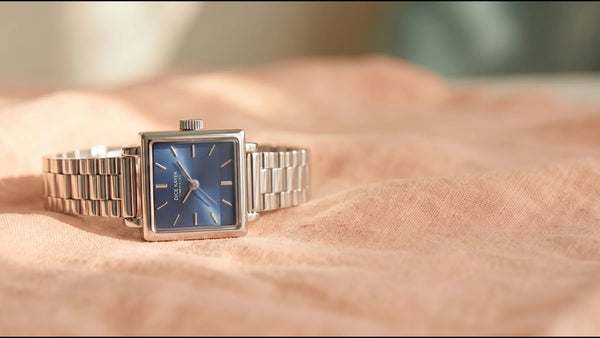
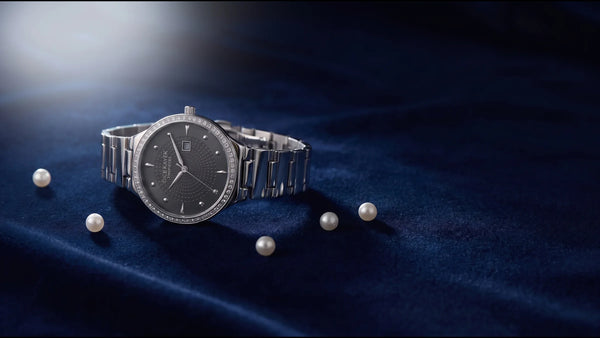
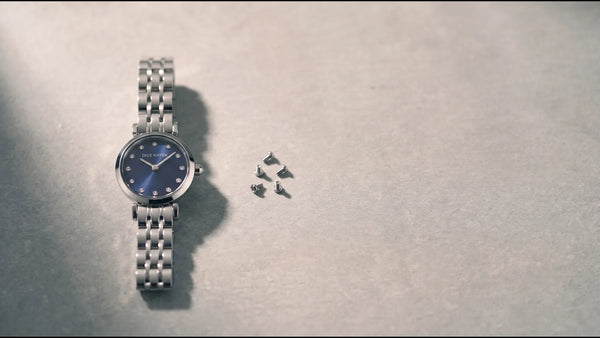
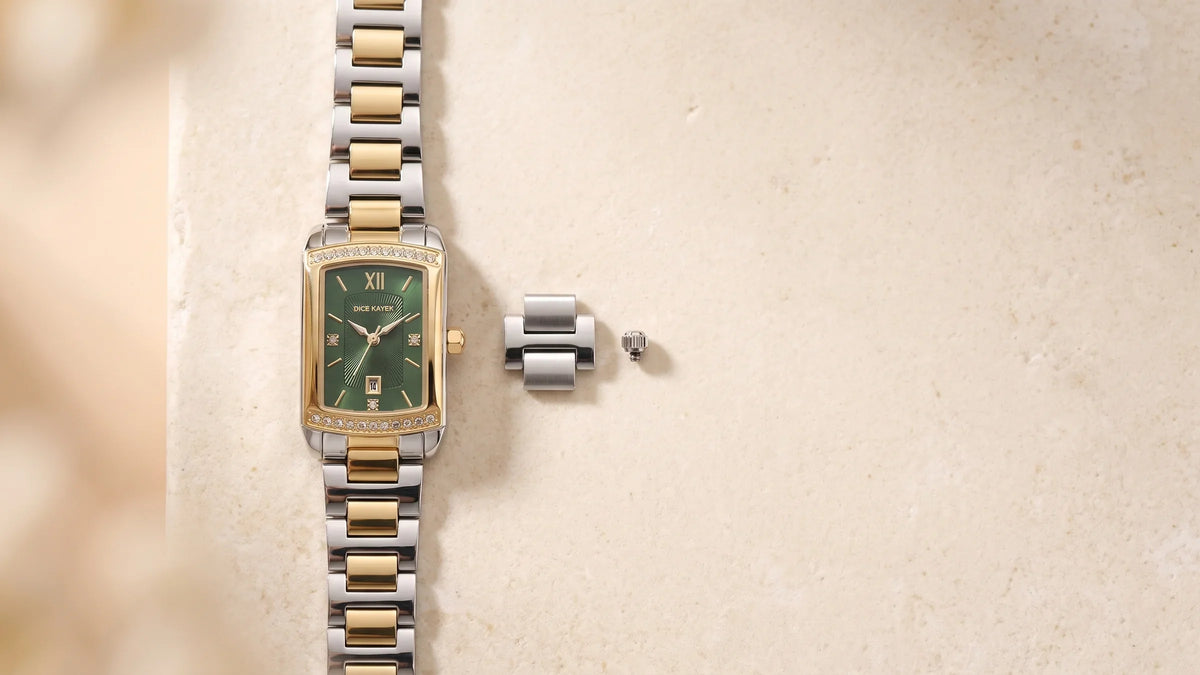
The collections differ mainly in dial and bezel design: stone details on Lumina, Roman-numeral indices on Romana, clean baton indices on Pura, coloured dials on Bloom. You can compare the parts described in this guide by looking at the product photographs:
Every watch carries a 2-year warranty against manufacturing defects; the service and battery-change process is explained on the warranty and service page. You can make a return or exchange within 30 days of delivery without giving a reason; shipping within Türkiye is free and orders are dispatched within 2 business days at the latest (shipping and delivery).
Collection
Take a closer look at case, dial and bezel details
Use the case shape, dial colour and case colour filters to compare the parts in this guide on real models.
Browse women’s watchesFrequently asked questions
What are the parts of a watch?
The exterior parts of a wristwatch are the case, case back, bezel, crystal, dial, indices, hands, crown, lugs, strap and clasp. The interior parts are the movement, the gaskets and, in quartz watches, the battery.
What is inside a watch?
Inside the case of a watch are the movement, dial, hands and gaskets. In a quartz watch the movement consists of a battery, a quartz crystal, a circuit and a stepper motor; a mechanical watch has a mainspring, gears and a balance wheel.
What are watch lugs?
Lugs are the projections at the top and bottom of the case. The strap is attached between two lugs with a spring bar, and the distance between the lugs sets the strap width.
What is a bezel?
A bezel is the ring that holds the watch crystal in place and frames the dial. It can be fixed or rotating; on women’s watches it is usually fixed and decorative, while dive watches use a unidirectional rotating bezel to track elapsed time.
What does the crown do?
The crown is the small knob on the side of the case used to set the time and date; on mechanical watches it also winds the mainspring. After setting, it must be pushed fully home, otherwise water can get into the case.
What is a case back?
The case back is the rear cover of the watch case that rests against the wrist. There are four basic types, snap-off, screw-down, screwed and unibody, and it is opened at an authorised service centre for work such as battery changes.
What is a watch dial?
The dial is the surface under the watch crystal on which time is read. It carries the indices, hands and, where present, a date window, and comes in finishes such as sunray, mother-of-pearl or matt.
What does a watch case include?
A watch case is the body that holds the movement, dial and crystal; the bezel, case back, crown and lugs are also part of the case. Case diameter is the widest measurement of the case, excluding the crown.
How do you measure lug width?
Lug width is found by measuring the distance between the inner edges of the two lugs with a ruler, in millimetres. This value is the width of strap the watch can take; on women’s watches it is usually a small even number.
What is an index on a watch?
An index is a mark on the dial that shows an hour position. It can be a baton, a dot, an Arabic numeral, a Roman numeral or a stone, and it sets the character of the watch.
What is a glossary of wristwatch terms?
A glossary of wristwatch terms is a list that brings together short explanations of the technical words used on product sheets, such as case diameter, lug-to-lug, ATM, bezel, complication and spring bar.
About this article
Written by: Dice Kayek Timepieces · Last updated: 9 October 2026
Part definitions and technical terms have been checked against the sources below. Measurements for Dice Kayek products (case diameter, water resistance) vary by model; exact values are on each product page.
Sources: