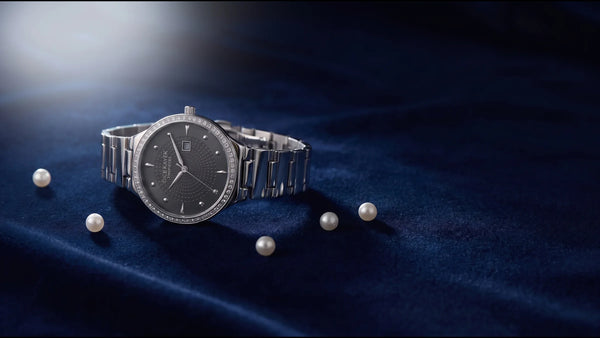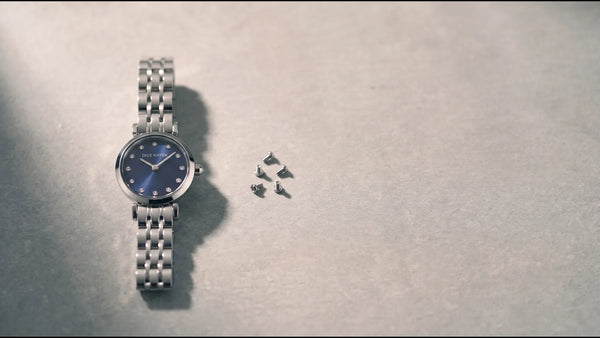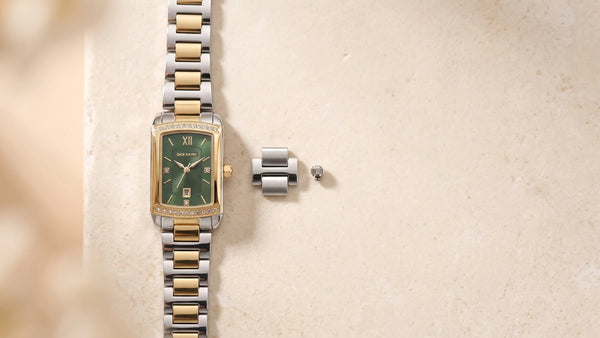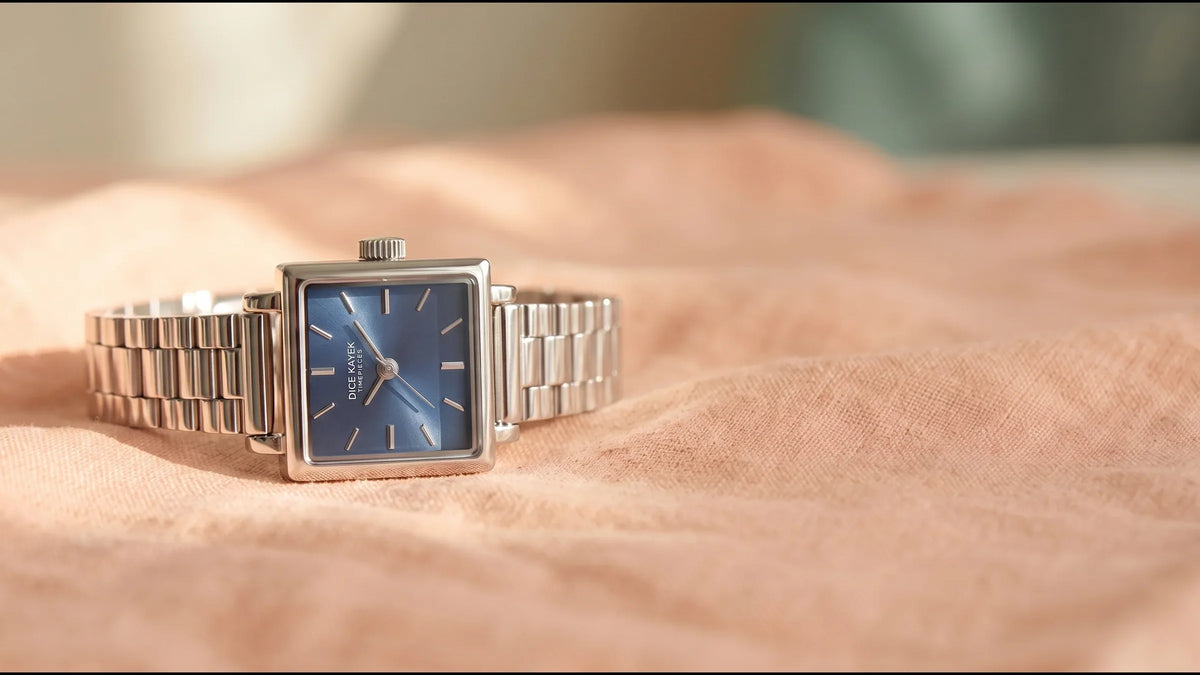
Short answer: A watch dial is the surface on which time is read on an analog watch: the plate that sits under the crystal and behind the hands, carrying the indices, the logo and, where present, a date window. The dial’s structure, material and finish decide both how easily the watch reads and how it looks on the wrist.
The short answer to “what is a watch dial” fits in one sentence; but the reason two watches in the same colour can look completely different lies in the dial’s layers, material and surface finish. This guide explains the parts that make up a dial, the materials dials are made from, finishes such as sunburst, guilloché and mother-of-pearl, and the types of indices, one by one.
The 30-second summary
- The dial is the “face” of the watch; the hands sit above the dial and the crystal above the hands.
- Dials are mostly made from a metal plate such as brass; mother-of-pearl, enamel and stone are more special options.
- Sunburst is brushed outwards from the centre, guilloché is a machine-engraved pattern and mother-of-pearl is cut from a natural shell layer.
- An index is a mark showing an hour position: a Roman numeral, an Arabic numeral, a baton, a dot or a stone.
- Dial diameter is not the same as case diameter; the measurement on product pages is the case diameter.
What is a watch dial?
Short answer: The answer to “what is a watch dial” is this: a dial is the plane on an analog watch that shows the time with numbers, marks and moving hands. The long hand is the minute hand and the short hand is the hour hand. On digital watches a screen does the same job, so the term “dial” is mostly used for analog watches.
A dial does not only show the time; it also sets the watch’s character: the same case and the same movement can look classic, minimal or bold with a different dial. For how the dial relates to the other parts of a watch (case, bezel, crown, lugs), see our watch parts and names guide; this article focuses on the dial itself.
What parts make up a watch dial?
Short answer: A watch dial consists of the dial plate that carries everything, the dial feet that fix the plate to the movement, the indices that mark the hour positions, the minute track that carries the minute divisions, the logo and printing and, where present, a date window and sub-dials. The hands are not part of the dial; they are fitted to arbors that pass through the hole in its centre.
| Part | What it does | Worth knowing |
|---|---|---|
| Dial plate | The dial’s supporting body; colour and texture sit on this surface | Material and finish decide the look |
| Dial feet | Small pins on the back of the plate that fix the dial to the movement | A replacement dial must match the movement |
| Indices | Marks showing the hour positions | Can be printed or applied as separate parts |
| Minute track | The minute divisions around the dial | On some models it sits on the sloped ring at the crystal’s edge |
| Logo and printing | The brand name and dial text | Crisp printing is a sign of workmanship |
| Date window | An aperture showing the date disc below | Usually at 3 o’clock |
| Sub-dials | Small dials for extra indications | Found on multifunction and chronograph watches |
Indices are made in two ways: they are printed on the dial or applied to the plate as small separate parts. Applied indices stand in relief and catch the light; printed indices are flatter and simpler. Because of the dial feet, a dial can only be fitted to a compatible movement, which is why replacing a dial is a job for an authorised service centre.
What is a watch dial made of?
Short answer: Watch dials are mostly made from a metal plate that is easy to work, such as brass; colour, printing and lacquer are applied on top of this plate. More special dials use mother-of-pearl, enamel or natural stone. The material decides how the dial carries colour, how it reflects light and how hard it is to repair.
| Material | Look | Note |
|---|---|---|
| Brass | An even surface suited to colour, printing and lacquer | The most common dial plate material |
| Aluminium | Light; usually coloured by anodising | On sports and field watches |
| Mother-of-pearl | Natural, iridescent sheen; every piece is different | Changes colour in the light |
| Enamel | A smooth, deep surface that holds its colour | Demanding to make and to repair |
| Natural stone | Patterns such as malachite, lapis lazuli and onyx | More fragile; rare and special |
Mother-of-pearl (nacre) is a natural material that forms the inner layer of some mollusc shells; pearls are made of the same material. It is strong and iridescent, so when a thin slice is used as a dial, it changes colour with the light. Because it is natural, no two mother-of-pearl dials are identical.
Sunburst, guilloché, mother-of-pearl: what do dial finishes mean?
Short answer: Dial finishes are surface treatments that make the same colour look different. A sunburst finish is made by brushing the dial outwards from the centre, so light fans across it as the wrist turns. Guilloché is a repeating pattern engraved by machine. A matt dial does not reflect light, while a polished dial makes colour look deep.
| Finish | How it is made | How it looks in light | Who it suits |
|---|---|---|---|
| Sunburst | Radial brushing from the centre outwards | Light fans across the dial as the wrist turns | Those who want depth on a simple dial |
| Guilloché | A precise, repeating pattern engraved by machine | The pattern comes alive in the light | Lovers of classic detail and craftsmanship |
| Mother-of-pearl | A thin slice of a natural shell layer | Iridescent; changes colour with the angle | Those after a jewellery effect |
| Matt | A flat, low-reflection surface | Does not shine; the easiest to read | Those who put legibility first |
| Polished / glossy | A polished or lacquered surface | Colour looks deep; fingerprints and dust show | Evening and special-occasion watches |
Guilloché is the mechanical engraving of a very precise, repeating pattern onto a surface; it gives finer and more regular lines than hand engraving. A dial’s finish does not always come through fully in product photos, so it is a good idea to look at images taken in different light and, if possible, to see sunburst and mother-of-pearl dials in daylight.
What is an index? Are Roman numeral dials easy to read?
Short answer: An index is a mark on the dial that shows an hour position; it can be a Roman numeral, an Arabic numeral, a baton, a dot or a stone. A Roman numeral dial is easy to read: because the numerals sit at the hour positions, the time is understood from position without reading the numeral. What really decides legibility is the contrast between dial and indices, more than the index type.
| Index type | Look | Legibility |
|---|---|---|
| Roman numeral | Classic, formal | Good; read by position |
| Arabic numeral | Clear, sporty or vintage | The easiest to read |
| Baton | Modern, minimal | Good; contrast matters |
| Dot | Soft, simple | Moderate; take care on small dials |
| Stone | Jewellery effect, sparkling | Varies with the light |
On Roman numeral dials, writing 4 as “IIII” instead of “IV” is a common watchmaking tradition, not a mistake. If you are looking for a Roman numeral dial, some models in a classic style:
All Roman numeral models are on our Romana collection page. If you prefer simple dials with baton indices, see our Pura collection:
What is the difference between the dial, the case and the crystal?
Short answer: The dial is the inner surface on which time is read; the case is the body that holds the dial and movement; the crystal is the transparent cover that protects the dial and hands. The “case diameter” on product pages is the widest measurement of the case, excluding the crown; the dial diameter is smaller, because the bezel and the case edge sit in between.
This difference also affects how large the watch looks on the wrist: on a watch with a slim bezel the dial looks larger, and on one with a thick bezel it looks smaller. To choose a case diameter for your wrist size, see our guide to how to choose a women’s watch. A comparison of crystal types (acrylic, mineral, sapphire) is in our watch parts guide.
How do you choose a dial colour?
Short answer: A dial colour is chosen around two questions: where will you wear the watch most, and is colour or legibility your priority? White, silver and mother-of-pearl dials are the easiest to read and go with every outfit; green, blue and coloured dials bring character to the fore. Also consider how the colour looks together with the finish.
The balance between legibility and character is covered in detail in how to choose a women’s watch; to see models by dial colour, visit our watches by dial colour page. For matching the strap colour, our watch strap types guide helps. Some coloured dials that stand out:
All models with coloured and pastel dials are in our Bloom collection.
How can you tell a dial is easy to read?
Short answer: On an easy-to-read dial the hands reach the indices, the colour of the hands and indices stands out clearly from the background, the dial is not crowded with unnecessary text and the surface does not reflect light enough to dazzle. You can check all of this in a few seconds before buying.
- Check the contrast. Silver hands can disappear on a white dial; bright hands on a dark dial read instantly.
- Look at hand length. The minute hand should reach the minute track and the hour hand should come close to the indices.
- Count the clutter. The more sub-dials and text, the harder it is to read the time at a glance.
- Try it in the light. Polished and mother-of-pearl surfaces shine at some angles; look in daylight and indoors.
- Think about the dark. If you want night-time legibility, check the product description for luminous paint on the hands and indices.
Luminous paints today are mostly made with phosphorescent materials such as strontium aluminate, which glow for a while after absorbing light. The radium paints used in the early 20th century have been banned in many countries because of health risks. One more note: in watch advertising the hands are traditionally set to around 10:10; the position looks like a smile and leaves the logo unobscured.
What dial options do Dice Kayek watches offer?
Short answer: Dice Kayek Timepieces collections differ by dial language: Bloom stands out with coloured and pastel dials, Romana with Roman numeral indices, Pura with minimal dials and Lumina with stone-set details. On every model the dial is protected by hardened mineral glass; the dial colour and case diameter are listed in the specifications table on each product page.
Every watch has a quartz movement, a solid stainless steel case and, depending on the model, 3–5 ATM water resistance. We recommend looking closely at the product photos for the dial finish and index type, and checking the case diameter to see how the dial will sit on your wrist.
Dial colour
Choose your dial by colour
Compare every dial colour, from white to green and from mother-of-pearl to black, on a single page.
Watches by dial colourFrequently asked questions
What is a watch dial?
A watch dial is the plane on an analog watch that shows the time with numbers, marks and moving hands. It sits under the crystal and behind the hands, and carries the indices, the logo and, where present, a date window.
What is the face of a watch called?
On analog watches, the surface on which time is read is called the dial. On digital watches an LCD or LED screen does the same job and is usually called the display.
What is the difference between the dial and the case?
The dial is the inner surface on which time is read; the case is the body that holds the dial, the movement and the crystal. The case diameter on product pages is larger than the dial diameter, because the bezel and the case edge sit in between.
What is a watch dial made of?
Watch dials are mostly made from a metal plate that is easy to work, such as brass; colour, printing and lacquer are applied on top of it. More special dials use mother-of-pearl, enamel or natural stones such as malachite and onyx.
What is a mother-of-pearl dial?
A mother-of-pearl dial is made from a thin slice of natural nacre, the material that forms the inner layer of some mollusc shells. It is iridescent, changes colour with the angle of the light and, being natural, no two are identical.
What does sunburst dial mean?
A sunburst dial is a dial whose surface has been brushed radially outwards from the centre. As the wrist turns, light fans across the dial, adding depth to a simple design.
What is guilloché?
Guilloché is a decorative technique in which a very precise, repeating pattern is engraved onto a surface by machine. On dials it creates fine patterns that come alive in the light and is used on classic, craft-focused watches.
What is an index on a watch?
An index is a mark on the dial that shows an hour position. It can be a Roman numeral, an Arabic numeral, a baton, a dot or a stone, and it can be printed on the dial or applied as a separate part.
How do you choose a dial colour?
A dial colour is chosen around where you will wear the watch and whether legibility or character comes first. White, silver and mother-of-pearl dials are the easiest to read and suit every outfit; green, blue and coloured dials bring character to the fore.
Are Roman numeral dials easy to read?
Yes. Because Roman numerals sit at the hour positions, the time is understood from position without reading the numeral. What really decides legibility is the contrast between the numerals and the dial background.
What is a watch crystal?
The watch crystal is the transparent cover that protects the dial and hands. There are three main types, acrylic, mineral and sapphire, and they differ in how well they resist scratches.
About this article
Written by: Dice Kayek Timepieces · Last updated: 9 October 2026
The dial definition and details of materials and finishes have been checked against the sources below. Dial colours and measurements for Dice Kayek products vary by model; exact information is on each product page.
Sources: