Short answer: A stainless steel watch is a wristwatch whose case, and usually its bracelet, is made of stainless steel. Stainless steel contains at least 10.5% chromium; a thin chromium oxide film forms on its surface, protects the metal from corrosion and repairs itself in the presence of oxygen when scratched. That is why a steel watch stands up to sweat, rain and daily wear, is easy to clean and keeps its colour for years. It has a limit too: if sweat and salt water are left on it for a long time, even stainless steel can stain.
This guide treats the steel watch as a material decision: why stainless steel does not rust, when it can stain, how it differs from aluminium and plated alloys, how heavy it feels on the wrist, the allergy question and how to clean it properly. Strap types and how to adjust a steel bracelet are covered separately in our guide to watch strap types.
Contents
- What is a stainless steel watch?
- What is the difference between solid steel and a plated watch?
- Does a stainless steel watch rust or tarnish?
- Steel watch, or an aluminium or titanium watch?
- Is a women's watch with a steel bracelet heavy?
- Can a steel watch cause a skin allergy?
- Does a steel watch scratch?
- How do you clean and care for a steel watch?
- What should women look for when choosing a steel watch?
- What materials are used in Dice Kayek steel watches?
- Frequently asked questions
What is a stainless steel watch?
A stainless steel watch is a wristwatch whose case, and usually its bracelet, is made of stainless steel. Stainless steel is the general name for a family of corrosion-resistant steels containing at least 10.5% chromium. The oxide film, a few nanometres thick, that chromium forms with oxygen protects the surface and quickly re-forms in the presence of oxygen when it is scratched.
In everyday language, "steel watch" describes two parts together: the case (the body that holds the movement and dial) and the bracelet (the band around the wrist). Some watches have a steel case with a leather or mesh strap; in a full steel watch both are stainless steel. Checking the "stainless steel case" and "stainless steel bracelet" lines separately in the specifications makes the difference clear.
Other elements such as nickel and molybdenum are added to stainless steel, and these additions define its grade. The grade most often mentioned for watch cases is 316L; it contains 2–3% molybdenum and resists chloride environments (salt, sweat) better than grade 304. Not every manufacturer lists the steel grade in its specifications.
What is the difference between solid steel and a plated watch?
In a solid steel watch, the case and bracelet are stainless steel all the way through; even if the surface is scratched, the same steel lies underneath. In a plated watch, a brass or other alloy body is covered with a thin metal layer; if the plating wears, the differently coloured base metal shows and touches the skin.
A gold, rose or black watch can also be solid steel: in that case the colour comes from a surface treatment such as ion plating (IP) applied over the steel body, and the material underneath is still stainless steel. So a "gold" or "rose" watch does not automatically mean a plated alloy watch. We explain how long gold-tone plating lasts and how it differs from solid gold in our article on gold watch models.
| Construction | Body material | Where does the colour come from? | What happens over time? |
|---|---|---|---|
| Solid stainless steel (steel colour) | Stainless steel | The steel's own colour | Scratches appear; the colour does not change |
| Solid stainless steel (gold, rose, two-tone) | Stainless steel | Ion plating over steel | The tone may lighten on edges that rub; steel remains underneath |
| Plated alloy | Brass or another alloy | Metal plating over the alloy | If the plating wears, a differently coloured base metal shows |
Does a stainless steel watch rust or tarnish?
A stainless steel watch does not rust or tarnish in normal use; however, "stainless" is not an absolute guarantee. If sweat, moisture or dirt is left on the bracelet and case for a long time, rust stains can form even on stainless steel. Salt and chlorine, and dirt left uncleaned between the links, raise the risk the most.
Seiko's instruction manual states this limit clearly: moisture, sweat or dirt left for a long time can cause rust even on a stainless steel band, so the band should be wiped with a soft cloth as soon as possible.
The grade of steel matters as well. Grade 316/316L, thanks to its molybdenum content, resists chloride environments better than grade 304; even so, technical data sheets state that 316 steel is still prone to pitting in warm chloride environments and warm sea water. That is why wiping and drying the watch after the sea, the pool or heavy sweating matters.
| Situation | Risk | What to do |
|---|---|---|
| Daily wear, office, city | Very low | Wiping with a dry cloth once a week is enough |
| Heavy sweat (sport, hot weather) | Medium | Wipe with a damp, then a dry cloth soon after |
| Sea water, pool chlorine | Medium–high | After contact, wipe with a cloth dampened in fresh water and dry |
| Dirt built up between links | Medium | Clean the bracelet with a soft toothbrush |
| Perfume, lotion, cleaning chemicals | Medium | Put the watch on after these have dried |
Steel watch, or an aluminium or titanium watch?
A steel watch is a balanced choice between durability, weight and easy care. Aluminium is noticeably lighter but a softer metal, and it dents more easily than steel on impact. Titanium is lighter than steel and strong, but it appears in fewer watch models and usually in a higher price range.
The density of aluminium is about one third that of steel, so an aluminium case of the same size feels much lighter on the wrist. Pure aluminium, however, is a soft metal; products such as watches use alloys with increased hardness. The table below compares the materials for everyday wear on the wrist; the values are general tendencies and vary by model.
| Material | Weight on the wrist | Corrosion resistance | Scratches and impact | Who is it for? |
|---|---|---|---|---|
| Stainless steel | Medium–substantial | High (with care) | Takes fine scratches, withstands impact | Those who want a long-lasting watch for every day |
| Aluminium | Very light | Good (oxide film) | Soft; dents and scratches more easily | Those who want the lightest watch, sport use |
| Titanium | Light | Very high | Can scratch, strong | Those who want lightness and durability together |
| Plated alloy | Medium | Good while the plating is intact | Base metal shows once the plating wears | Short-term, fashion-led use |
Is a women's watch with a steel bracelet heavy?
A women's watch with a steel bracelet feels more substantial on the wrist than one with a leather or silicone strap; whether it is "heavy" depends on the case diameter, case thickness and the number of links in the bracelet. A slim-cased women's steel watch with a narrow bracelet is comfortable all day; wide cases and thick links feel noticeably heavier.
Often the real cause of a heavy feeling is poor fit. A loose steel bracelet slides on the wrist and the weight of the watch knocks against the wrist bone; a correctly adjusted bracelet spreads the weight evenly. Seiko also recommends leaving enough room between the band and the wrist to fit a finger. We explain how to adjust bracelet length step by step in our strap types and adjustment guide.
If you are sensitive to weight, look at two things: a case diameter that suits your wrist and the case height. You can find case diameter by wrist size in how to choose a women's watch. If possible, wear the watch for a while at your desk and while walking.
Can a steel watch cause a skin allergy?
A steel watch does not cause an allergy for most people; for people with a nickel allergy, however, the risk of a reaction is not entirely zero. Some stainless steel grades contain nickel in their alloy. European Union rules do not allow products in prolonged contact with the skin, such as watches, to release more than 0.5 micrograms of nickel per cm² per week.
Redness, itching or a rash on the wrist is not always a metal allergy. Seiko's manual notes that a band left without care can itself cause a rash together with sweat and dirt, and that an allergy to metals or leather is one possible cause. First clean the bracelet and try wearing the watch a little looser; if the complaint continues, take the watch off and see a dermatologist. If you have a known nickel allergy, ask the seller about the material before buying; this information is not medical advice.
Does a steel watch scratch?
Yes, a steel watch scratches over time. Stainless steel withstands impact, but its hardness is not enough to prevent fine surface scratches from sand, concrete, desk edges and jewellery. Polished surfaces show scratches more clearly; brushed (satin) surfaces hide fine scratches better.
Scratches do not reduce the corrosion resistance of stainless steel: the chromium oxide film re-forms with oxygen where the surface was scratched. We cover how scratches on the case and crystal are removed at home or by a service in our guide to removing scratches from a watch crystal and case and do not repeat it here.
How do you clean and care for a steel watch?
A steel watch is cared for by wiping it regularly with a soft cloth and occasionally cleaning between the links with a soft toothbrush. Sweat, moisture and dirt should be wiped off as soon as possible. When cleaning the bracelet with water, the case must be kept away from water so as not to exceed the watch's water resistance rating.
- Daily: When you take the watch off, wipe the case and bracelet with a dry, soft microfibre cloth.
- After sweat or the sea: Wipe the bracelet and case with a cloth lightly dampened in fresh water, then dry with a dry cloth.
- Between the links: Protect the case from water by wrapping it in cling film; wet only the bracelet and brush between the links with a soft toothbrush.
- Drying: Dry the bracelet completely with a soft cloth; leave no moisture between the links.
- Avoid: Do not use bleach, abrasive creams, metal polish or hard sponges; they wear both the polish and the ion plating.
- Pin check: If you notice rust or looseness in the bracelet pins, stop wearing the watch and take it for service.
A 3 ATM watch only withstands splashes, so do not wash it under the tap. Whatever the water resistance rating, do not pull out the crown with wet hands. You can find the other steps of watch care in our watch care guide.
What should women look for when choosing a steel watch?
When choosing a steel watch for women, first check that both the case and the bracelet are stainless steel, then look at the colour tone, case diameter and water resistance rating. A bracelet that can be adjusted to your wrist and a clasp that closes securely matter as much as the material for everyday comfort.
| Criterion | What to check | Why it matters |
|---|---|---|
| Case and bracelet material | Does the specification say "stainless steel" for both? | A plated alloy may wear in the long term |
| Colour tone | Steel colour, gold, rose or two-tone | Harmony with your jewellery and skin undertone |
| Case diameter | Does it suit your wrist size? | It sets the feel of weight and proportion |
| Bracelet type | Link steel or mesh? | Link bracelets look fuller, mesh looks slimmer |
| Water resistance | 3 ATM or 5 ATM? | Safety margin against hand washing, rain and splashes |
| Crystal | Mineral, hardened mineral or sapphire | It determines the crystal's scratch resistance |
Colour tone is a personal preference, not a rule. Steel-coloured (silver-tone) watches go well with silver and white-gold jewellery, gold-tone models with gold jewellery, and two-tone models are a flexible option for those who wear both tones. We cover the style side in detail in our women's watch style guide. All silver-tone models are in the silver women's watches collection.
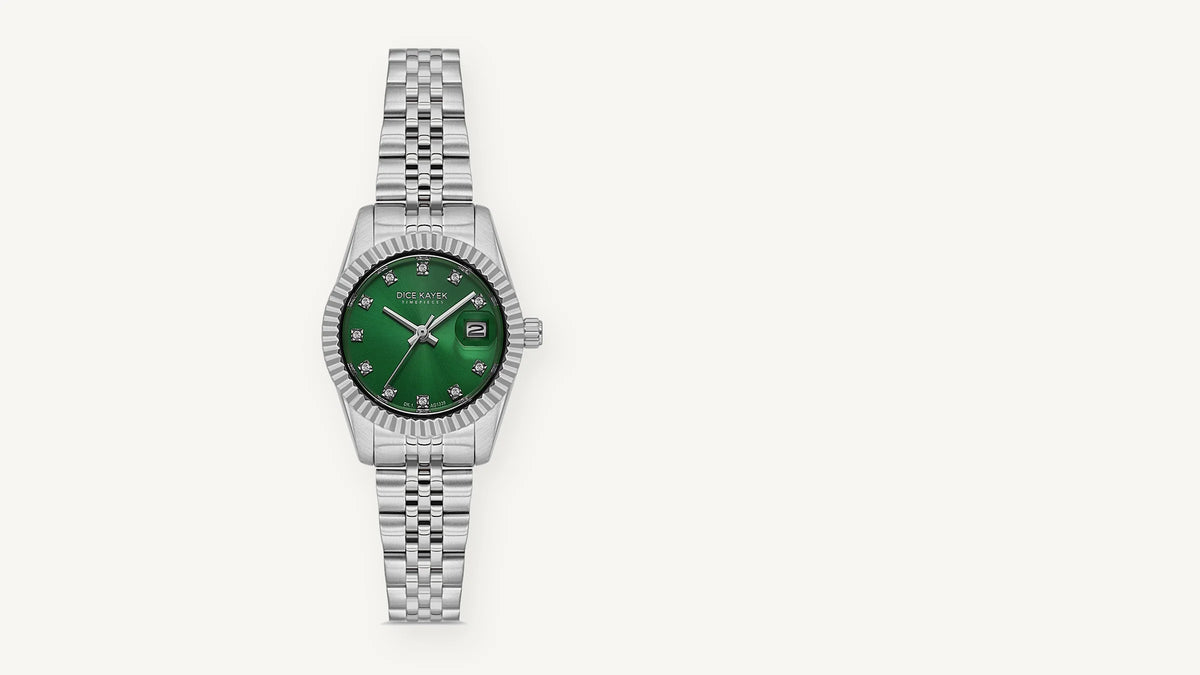
Models that stand out with a steel-coloured case and bracelet:
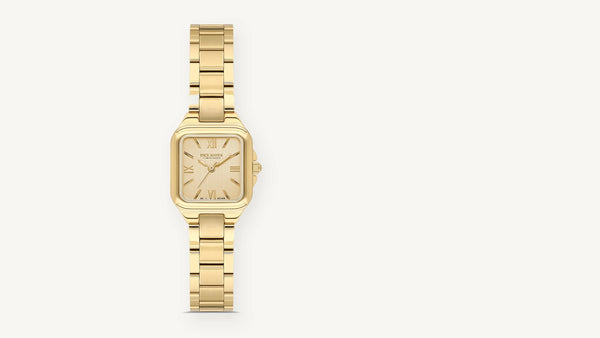
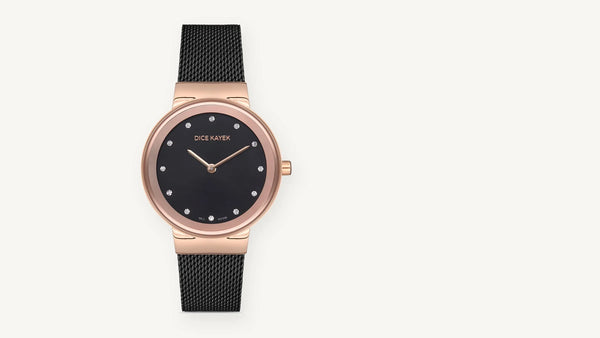
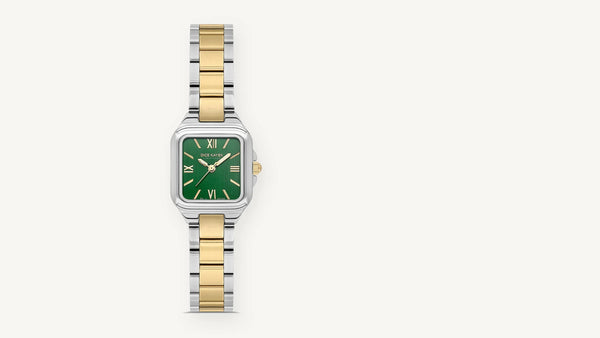
Gold, rose and two-tone shades on a stainless steel body:
What materials are used in Dice Kayek steel watches?
In Dice Kayek watches, the case and bracelet are solid stainless steel; the crystal is hardened mineral glass and the movement is quartz. Water resistance is 3 ATM or 5 ATM depending on the model. In gold, rose and two-tone models, the colour is applied by ion plating over the steel body. The exact case diameter and ATM value are listed in the technical specifications on each product page.
Dice Kayek watches carry a 2-year warranty against manufacturing defects. Battery replacement, bracelet adjustment, drops and impacts, normal wear and exposure beyond the water resistance rating are not covered; details are on our warranty and service page. If the watch does not meet your expectations after trying it on, you can return it within 30 days of delivery; watches engraved on the caseback are excluded.
You can explore all steel bracelet models in the women's steel bracelet watches collection.
Solid stainless steel
Choose your everyday steel watch
In Dice Kayek models, the case and bracelet are solid stainless steel; shipping within Türkiye is free and you can return your watch within 30 days of delivery.
Explore steel bracelet watches →Frequently asked questions
What is a stainless steel watch?
A stainless steel watch is a wristwatch whose case, and usually its bracelet, is made of stainless steel. Stainless steel contains at least 10.5% chromium; the chromium oxide film on its surface protects the metal from corrosion. That is why a steel watch is durable, resists sweat and water and is easy to clean.
Does a stainless steel watch rust?
A stainless steel watch does not rust in normal use. However, if sweat, moisture, salt water or dirt is left on the bracelet for a long time, rust stains can form even on stainless steel. Wiping the watch with a damp and then a dry cloth after contact greatly reduces this risk.
What is the difference between a steel watch and an aluminium watch?
Aluminium has about one third the density of steel, so an aluminium watch is much lighter. On the other hand, aluminium is a softer metal and dents and scratches more easily on impact. A steel watch feels more substantial but withstands impact better and keeps its shape for many years.
Does a steel watch scratch?
Yes. Stainless steel withstands impact but picks up fine surface scratches over time; polished surfaces show them more, brushed (satin) surfaces less. Scratches do not affect the steel's stainless quality, because the protective oxide film re-forms where it was scratched.
Can a steel watch cause a skin allergy?
For most people it does not; however, because some stainless steel grades contain nickel, the risk of a reaction is not entirely zero for people with a nickel allergy. EU rules limit nickel release from products in prolonged contact with the skin. If redness or itching occurs, take the watch off and see a dermatologist.
How do you clean a steel watch?
Wipe the case and bracelet with a soft cloth. For dirt between the links, protect the case from water with cling film, wet only the bracelet, brush it with a soft toothbrush and then dry it completely. Do not use bleach, abrasive creams or metal polish.
Is a steel watch waterproof?
Whether a watch lets water in depends on its water resistance rating, not its material. A 3 ATM watch only withstands splashes, rain and hand washing; a 5 ATM watch tolerates more frequent contact with water. The steel case does not rust, but the gaskets wear with heat and time; take the watch off for hot showers and saunas.
Is a women's watch with a steel bracelet heavy?
It feels more substantial than a leather strap, but the weight depends on the case diameter, case thickness and number of links. Slim-cased models with a narrow bracelet are comfortable all day. A correctly adjusted bracelet spreads the weight evenly on the wrist; a loose bracelet makes the watch feel heavier.
Does a steel watch change colour?
The natural colour of a steel-coloured watch does not change in normal use; the dullness sometimes seen on the surface is usually sweat, lotion and dirt and disappears when wiped. In gold, rose or black models, the colour comes from plating applied over the steel; this tone may lighten over time on edges that rub.
How do you care for a steel watch?
Wipe the watch with a dry cloth after each wear, clean it with a damp cloth and dry it after sweat or the sea, and occasionally clean between the links with a soft brush. Apply perfume and lotion before putting the watch on. If you notice loose pins or rust, take the watch for service.
Is a steel watch a good choice?
If you want an everyday, long-lasting and easy-care watch, a steel watch is a good choice: it withstands impact, resists sweat and water and keeps its colour. If you want the lightest possible watch or your wrist is sensitive to the weight of metal, a leather strap or a smaller case may feel more comfortable.
How do you clean a rusty watch?
For surface stains on the bracelet, protect the case from water, wet the bracelet with lukewarm water, clean it with a soft toothbrush and dry it completely. If rust has advanced into the pins or inside the links, the pins may loosen; in that case stop wearing the watch and take it to a watch service. Do not use abrasive products.
Related guides: What Is Ion Plating? · How to Clean a Watch
About this article
Prepared by: Dice Kayek Timepieces · Last updated: 16 November 2026
The technical information in this guide is based on Dice Kayek Timepieces product specifications and on manufacturers' published user manuals. For exact values, see the technical specifications table on each product page; prices and stock are read live.
Sources: ASSDA — What is stainless steel? · Stainless UK — Grade 316/316L specification sheet · Seiko — Band care (instruction manual) · Danish Environmental Protection Agency — Nickel fact sheet