Short answer: Ion plating (IP) is a process in which a coating material is vaporised in a vacuum chamber and deposited on metal as a thin film while the surface is continuously bombarded with ions. It belongs to the physical vapour deposition (PVD) family. On watches it is used to give steel cases and bracelets colours such as gold, rose or black. The layer is a few microns thick; it is hard and adheres well, but it is not permanent: it can wear at friction points over time and scratch under a hard knock.
"IP" or "PVD" in a watch's specifications describes a manufacturing method, not a material. This guide explains how the layer is formed, how it differs from electroplating and how long it lasts. The difference between solid gold, gold plating and gold colour is covered in our gold watch models guide.
Contents
- What is ion plating?
- How is ion plating done?
- What is the difference between ion plating, PVD and electroplating?
- What is an ion-plated watch, and how are its colours made?
- How long does ion plating last? Does it tarnish or scratch?
- How do you clean and protect an ion-plated watch?
- What should you check when buying an ion-plated watch?
- Frequently asked questions
What is ion plating?
Ion plating is a physical vapour deposition (PVD) method that coats a surface with energetic, atom-sized particles in a vacuum. What sets it apart is that the surface is continuously bombarded with ions during coating. This bombardment cleans the surface and makes the thin film adhere more firmly to the metal. The result is a hard, coloured surface layer a few microns thick.
The method was first described in 1964 by Donald M. Mattox of Sandia National Laboratories. The aim was to improve the coating's adhesion to the surface. Today it is used for hard protective layers on cutting tools, dense films on optical parts and decorative colour layers on consumer products such as watch cases.
In watchmaking, "IP", "ion plating" and "PVD" are often used interchangeably. Technically, PVD is the umbrella term: every ion plating process is a PVD process, but not every PVD process is ion plating.
How is ion plating done?
Ion plating is done in four basic stages: the part is cleaned, placed in a vacuum chamber, given a final clean by ion bombardment and then coated with vaporised material while the bombardment continues. Uninterrupted bombardment is the main reason the layer adheres so well.
- Pre-cleaning: Case and bracelet parts are cleaned of oil, dust and polishing residue.
- Vacuum: The parts are placed in a sealed chamber and the air is pumped out.
- Ion bombardment: Usually inert gas ions are driven into the surface, stripping contaminants and oxides from its top layer.
- Deposition: The coating material is turned into vapour by evaporation, sputtering or an arc. If a reactive gas such as nitrogen is fed in, a compound layer such as titanium nitride forms.
- Inspection: Colour tone and surface evenness are checked.
Ion plating does not change the material beneath: a steel case is still steel. The watch's weight, water resistance and movement are unaffected by the coating.
What is the difference between ion plating, PVD and electroplating?
Ion plating is the member of the PVD family that uses ion bombardment. Electroplating is an entirely different process; the part is immersed in a liquid containing ions of the coating metal, and an electric current deposits the metal on the surface. PVD and ion plating are dry, vacuum-based processes.
| Feature | Ion plating (IP) | Other PVD methods | Electroplating |
|---|---|---|---|
| Environment | Vacuum chamber, ion bombardment | Vacuum chamber | Liquid electrolyte bath |
| How the layer forms | Vapour deposits on the surface under bombardment | Vapour deposits on the surface | Metal ions are deposited by electric current |
| Typical layer material | Hard compounds such as titanium nitride, or metals | Titanium nitride, chromium nitride, carbon-based (DLC) layers | Metals such as gold, silver, nickel, chromium |
| Thickness | A few microns | A few microns | Varies by application |
| Adhesion | High; bombardment was developed to improve adhesion | Good | Depends on surface preparation |
| Common use on watches | Yellow gold, rose, black, grey tones | Black and dark tones, hard surfaces | Real gold layer, jewellery and accessories |
The key difference is the layer material. In gold electroplating the layer is real gold; in ion plating the gold colour often comes from a compound such as titanium nitride, which looks gold when applied as a coating. Carat and value are covered in our gold watch models article.
What is an ion-plated watch, and how are its colours made?
An ion-plated watch is one whose case, and usually bracelet, is made from a base metal such as stainless steel and then given a coloured outer layer by ion plating. The watch keeps the strength of steel while gaining a colour such as gold, rose or black. The dial colour is independent of the case.
The colour comes from the layer's composition and thickness; changing the ratio of gases and metals gives lighter or warmer tones. That is why two makers' "rose" watches may not match exactly; this is not a defect but a difference in recipe. Judge a plated watch in daylight next to the rings and bracelets you wear. For matching colour to skin tone, see our how to choose a women's watch guide.
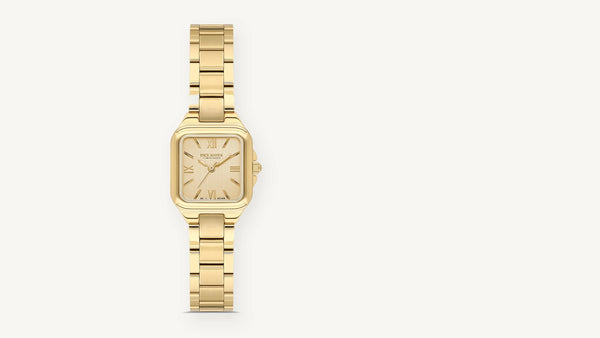
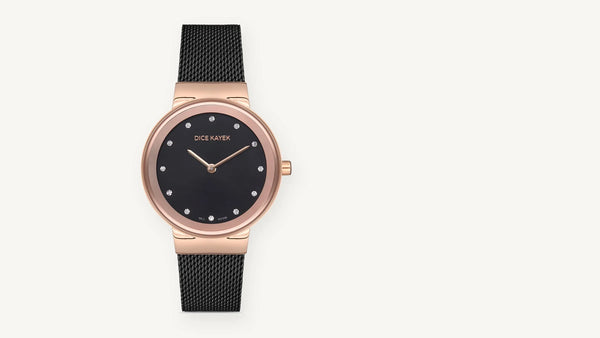
Featured plated women's watches in warm rose tones:
All warm-toned models are in the rose gold women's watches collection.
How long does ion plating last? Does it tarnish or scratch?
The lifespan of ion plating cannot be given in years; it depends on how the watch is worn. As a hard, well-bonded film it stands up well to daily contact. But it is only a few microns thick: at link joints, the clasp and the case edge that rubs against a desk it can thin over time and the steel beneath may show.
Tarnishing: Tarnishing usually describes metals such as silver darkening as they react with the air. With ion plating, the change people notice is usually not this but wear at friction points. Perfume, chlorine and salt water can cause dullness and marks. So it is not accurate to say "it never tarnishes or fades".
Scratching: Ion plating is not scratch-proof. Because the steel beneath is softer, a hard knock dents the steel and the thin layer can crack. A scratched coating cannot be fixed by polishing at home, because polishing removes the coating too; it can only be renewed by re-coating at a specialist service.
| Area / situation | What can happen? | What can you do? |
|---|---|---|
| Bracelet link joints | Gradual thinning from friction, steel colour showing | Have the bracelet sized to fit snugly; a loose bracelet rubs more |
| Clasp and case edge | Wear from desks, keyboards and bags | Slide the watch towards the outside of the wrist when typing |
| Perfume, cream, cologne | Dullness and marks | Apply cosmetics first and put the watch on once they are dry |
| Chlorinated or salt water | Residue and staining | After contact, wipe with a cloth dampened in fresh water and dry |
| Hard knock | Scratch or crack in the layer | Take the watch off for sport and heavy work |
Plating wear is a result of normal use and is not covered by the Dice Kayek Timepieces warranty; details are on the warranty and service page.
How do you clean and protect an ion-plated watch?
An ion-plated watch is cleaned by wiping it with a soft, dry microfibre cloth; if it is dirty, the cloth is lightly dampened and the watch is dried afterwards. Alcohol, acetone, bleach, toothpaste and metal polish can dull or wear the coating.
- Daily: When you take the watch off, wipe away sweat and cosmetic residue with a dry cloth.
- Weekly: Wipe between the links with a slightly damp cloth and dry; do not submerge the watch.
- Cosmetics: Apply perfume and lotion before putting the watch on.
- Storage: Do not pile the watch with rings and bangles; keep it in its own box.
- Risky tasks: Take the watch off for sport, gardening and cleaning.
Everything on batteries, water and storage is in our watch care guide.
What should you check when buying an ion-plated watch?
When buying a plated watch, look first at the base material, then at the plating colour and your wearing habits. If the metal beneath the coating is stainless steel, the surface underneath will not rust even if the layer wears; this matters even more than the plating method.
- Base material: Check whether the specifications list the case and bracelet as "stainless steel".
- Plating information: If the method (IP, PVD) is not stated, accept that you only know the plating colour and ask the seller.
- Bracelet type: Mesh and solid steel bracelets rub at different points; see the comparison in watch strap types.
- How often you wear it: If you wear the watch at a desk every day, expect the plating to wear faster on the clasp and case edge; this is not a defect but the nature of plating.
- Movement: Plating does not affect the inside of the watch; for details, see what is a quartz watch.
On Dice Kayek Timepieces models, the case and bracelet are solid stainless steel; the technical specifications table on each product page states the plating colour (gold, rose, silver) and the water resistance of 3 or 5 ATM depending on the model.
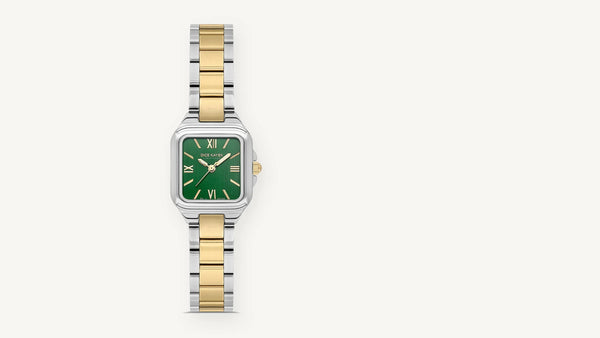
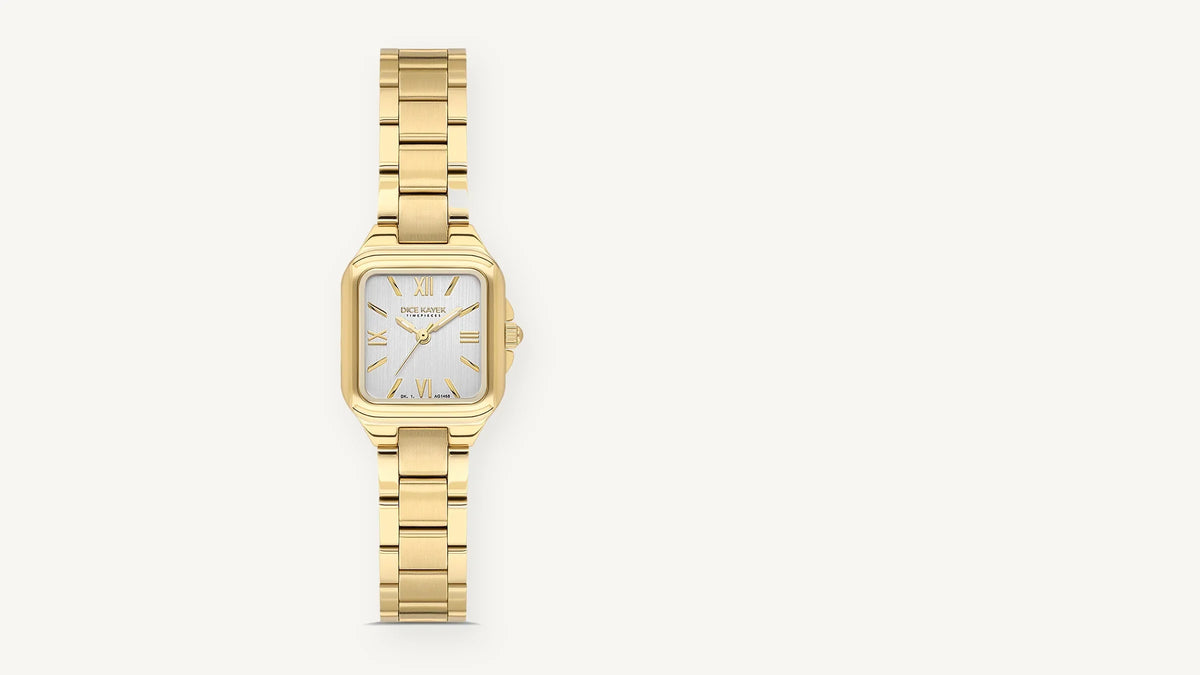
Featured gold-tone plated models for everyday wear:
More models are in the gold women's watches collection.
Explore warm tones
The gold-tone Solène collection
Compare gold and rose plated models by dial colour and bracelet type. Shipping within Türkiye is free, and you can return your watch within 30 days of delivery.
Explore the Solène collection →Frequently asked questions
What is ion plating?
Ion plating (IP) is the deposition of vaporised material on metal as a thin film a few microns thick while the surface is bombarded with ions in a vacuum. It is a PVD method and makes the layer adhere firmly.
What is an ion-plated watch?
It is a watch whose case, and usually bracelet, is made from a metal such as stainless steel and given a gold, rose or black layer by ion plating. The material beneath does not change; the watch is still steel.
Does ion plating tarnish?
The change people notice is usually not tarnishing but wear at friction points. Perfume, chlorine and salt water can cause dullness and marks. A well-cared-for coating can keep its colour for a long time, but none can be called fade-proof.
What is the difference between ion plating and gold plating?
Gold electroplating deposits real gold from a liquid bath using electric current. Ion plating is a dry process in a vacuum; the gold colour often comes from a gold-looking compound such as titanium nitride.
How long does ion plating last?
No exact number of years can be given; it depends on use. It stands up well to daily contact, but because it is only a few microns thick it can thin over time at the clasp, link joints and case edge.
Does ion plating scratch?
Yes. Because the steel beneath is softer, the layer can crack under a hard knock. A scratched coating cannot be fixed by polishing at home; renewal requires re-coating at a specialist service.
What is PVD coating?
PVD (physical vapour deposition) is the general name for methods in which a solid material is turned into vapour in a vacuum and deposited on a surface as a thin film. Ion plating is a member of this family.
Is an ion-plated watch water resistant?
Water resistance is determined by the case and gaskets, not the plating, and is stated as 3 ATM, 5 ATM and so on. Wiping the watch with a damp cloth and drying it after chlorinated or salt water protects the coating.
How do you clean ion plating?
Wipe it with a soft, dry microfibre cloth; if needed, lightly dampen the cloth and then dry the watch. Do not use alcohol, acetone, bleach or metal polish.
Is rose gold plating done with ion plating?
It can be. Rose tones can be achieved with ion plating and other PVD methods as well as with electroplating. If the specifications only state the colour, ask the seller about the method.
Is ion plating good?
It is a durable and accessible way to give a steel watch colour. Its limit is that the layer is thin: heavy friction and hard knocks will wear or scratch it.
Should you choose an ion-plated or a plain steel watch?
Uncoated steel can be refinished by polishing when scratched. A plated watch keeps the strength of steel while offering a gold, rose or black tone; in return, it can wear over time.
Related guides: Stainless Steel Watch
About this article
Prepared by: Dice Kayek Timepieces · Last updated: 16 November 2026
The technical information in this guide is based on Dice Kayek Timepieces product specifications and on manufacturers' published user manuals. For exact values, see the technical specifications table on each product page; prices and stock are read live.
Sources: Wikipedia — Ion plating · Wikipedia — Physical vapor deposition · Wikipedia — Titanium nitride · Wikipedia — Electroplating · WatchGecko — What is PVD or IP plating?