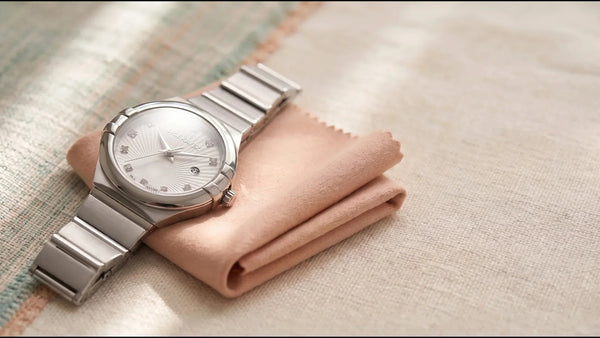
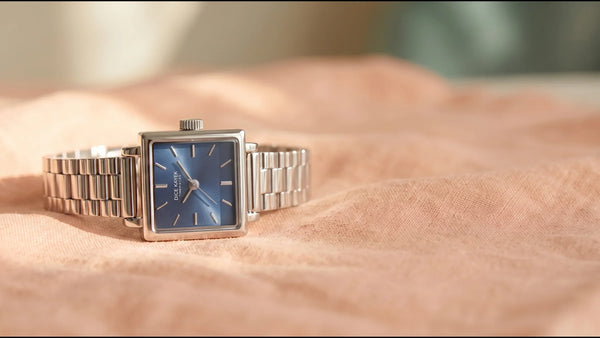
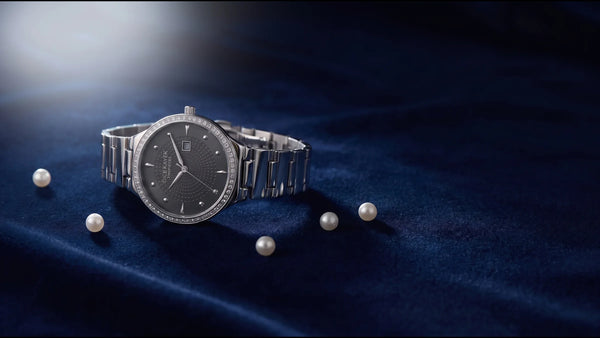
Short answer: Mineral glass is the silica-based glass that protects a watch dial, strengthened by heat or chemical treatment. It scratches less easily than acrylic and more easily than sapphire; in return, it tolerates knocks better than sapphire and costs less. Hardlex is the name Seiko gives its own hardened mineral glass.
The question “what is mineral glass” usually comes with “does it scratch?”. This guide explains what mineral glass is, what hardening changes, how Hardlex differs from mineral glass, why glass scratches and what scratches it, and how to protect it in everyday wear.
The 30-second summary
- Mineral glass is strengthened glass; it is one of the most common crystal types on watches.
- Ordinary glass is about 5.5 on the Mohs scale and sapphire is 9; hardening mainly improves impact resistance and raises scratch resistance only slightly.
- Hardlex is not a separate material but the trade name of Seiko’s hardened mineral glass.
- Mineral glass can scratch: the quartz in dust and sand (Mohs 7) is harder than glass.
- A deep scratch is usually removed by replacing the crystal, not by polishing.
What is mineral glass?
Short answer: Mineral glass is silica-based glass, used as the transparent cover over a watch dial, whose durability has been increased by heat or chemical treatment. In watchmaking it is one of the three main crystal types, alongside acrylic and sapphire, and it sits between them with a balance of price and durability.
The word “mineral” does not refer to an additive; it means the crystal is real glass made from mineral raw materials such as sand and silica, not plastic (acrylic). The term “mineral glass” is also used for spectacle lenses; this article focuses on watch crystals. For how the crystal relates to the other parts of a watch, see our watch parts and names guide, and for how it differs from the dial, see what a watch dial is.
What does hardened mineral glass mean?
Short answer: Hardened mineral glass is glass whose strength has been increased after production by heat treatment (tempering) or chemical treatment. Heat treatment puts the outer surface into compression, increasing resistance to knocks; chemical treatment also raises the glass’s strength. On product sheets it appears as “hardened mineral glass” or “hardened mineral crystal”.
| Glass | Treatment | What it adds | Note |
|---|---|---|---|
| Ordinary glass | None | Basic transparency | Mohs ≈ 5.5 |
| Heat-treated (tempered) mineral glass | Controlled heating and rapid cooling | Better resistance to knocks; breaks into small pieces | Common on watches |
| Chemically strengthened mineral glass | Chemical treatment after production | Strength increases markedly | Scratch resistance also rises somewhat |
| Hardlex | Seiko’s heat- and chemically treated glass | Seiko’s version of hardened mineral glass | A trade name specific to Seiko |
Hardening does not make glass scratch-proof; its main aim is to increase resistance to knocks and breakage. What really decides scratching is whether the material touching the glass is harder than the glass. So “hardened” should not be read as a promise of sapphire-level scratch resistance.
What is Hardlex, and how does it differ from mineral glass?
Short answer: Hardlex is the trade name Seiko gives the hardened mineral glass it uses on its own watches. It is made by strengthening ordinary glass with heat and chemical treatment. So Hardlex is not a separate material but a type of mineral glass; the difference comes from Seiko’s own hardening process and branding.
On Seiko product pages the crystal material is listed as “Hardlex”. Some watch publications note that hardening gives Hardlex higher scratch resistance than ordinary mineral glass, while it remains below sapphire. In practice, the difference between Hardlex and a good hardened mineral glass is much smaller than the difference between either of them and sapphire.
When it comes to “Hardlex or mineral glass?”, how you wear the watch matters more than the label: how often the watch meets hard surfaces and sand affects the life of the crystal more than the brand does.
Does mineral glass scratch?
Short answer: Yes, mineral glass can scratch. On the Mohs hardness scale, ordinary glass is about 5.5, while the quartz found in dust, sand and concrete is 7. Rubbing against a particle harder than glass leaves a scratch. Ordinary steel (4.5) is softer than glass, so on its own it does not scratch it; it is the sand on keys and coins, more than the metal, that does the damage.
| Material | Mohs hardness | Does it scratch mineral glass? |
|---|---|---|
| Ordinary steel | ≈ 4.5 | Usually not |
| Glass | ≈ 5.5 | Same hardness; can leave marks when rubbed |
| Quartz (sand, dust, concrete) | 7 | Yes; the main cause of everyday scratches |
| Sapphire (corundum) | 9 | Yes |
| Diamond | 10 | Yes |
This table explains why mineral glass can end up covered in fine marks: brushing against walls, setting the watch down on a sandy table or carrying it in the same pocket as keys create most small scratches. The Mohs scale is a rough ranking, but it is still a good guide to which contacts are risky.
Mineral glass or sapphire: which is more durable?
Short answer: It depends on which kind of “durability” you mean. Against scratches, sapphire (Mohs 9) is clearly more durable than mineral glass. Against a hard, sudden knock, mineral glass is more tolerant; sapphire is as brittle as it is scratch-resistant. Mineral glass is also more economical and easier to replace.
| Feature | Acrylic | Hardened mineral glass | Sapphire |
|---|---|---|---|
| Scratch resistance | Low | Medium | Highest |
| Knock tolerance | High; hard to break | Good | Can crack under a hard knock |
| Removing a scratch | Easy by polishing | Difficult; often replaced | Rarely scratches; replacement is costly |
| Cost | Lowest | Medium | Highest |
A short assessment of which crystal to choose for everyday wear is in our guide to how to choose a women’s watch; this article focuses on mineral glass itself.
How long does mineral glass last, and is it suitable for everyday wear?
Short answer: Mineral glass has no set “expiry”; its life is decided by how you wear it. In office and everyday use, hardened mineral glass can be worn for years without trouble. In jobs that involve frequent contact with sand, stone and hard surfaces, small scratches build up sooner. Thanks to its knock tolerance, it is a balanced choice for everyday wear.
The main things that shorten a crystal’s life are knocking the watch against hard surfaces such as door handles and table edges, wearing it in sandy environments such as the beach or a building site, and storing it in the same box as stone-set or metal jewellery. If the crystal cracks, stop wearing the watch; moisture entering through the crack can damage the dial and movement.
How do you clean and protect mineral glass?
Short answer: Mineral glass is cleaned by wiping it with a soft, clean microfibre cloth. The cloth can be dry or slightly damp; abrasive cleaning products, paper towels and hard sponges should not be used. Before cleaning, remove dust from the surface by blowing or lightly dabbing it, because dust particles can scratch the glass when rubbed with a cloth.
- Remove dust first. Blow the dust away or lift it with a light touch of the cloth before wiping.
- Use microfibre. A clean, soft microfibre cloth, like a glasses cloth, is enough.
- Avoid abrasives. Toothpaste, powdered glass cleaners and scouring creams can dull the glass or damage its coating.
- Keep the crown closed. Make sure the crown is fully closed when wiping the watch with a damp cloth.
- Store it separately. Keep the watch away from jewellery and keys, in a soft box or pouch.
General care steps for the case and strap are covered in our watch care guide.
Can scratches on mineral glass be removed?
Short answer: Very superficial marks can sometimes be softened by professional polishing; however, mineral glass does not polish as easily as acrylic, and the result is not always satisfactory. For deep scratches that you can see and feel with a fingernail, the most reliable solution is to have the crystal replaced at an authorised service centre. Trying abrasive products at home can dull the glass.
Checking the gasket during a crystal replacement is important to keep the watch’s water resistance. For Dice Kayek Timepieces watches, warranty coverage and the service process are explained on the warranty and service page; wear from use, such as scratched glass, is not covered as a manufacturing defect.
What crystal do Dice Kayek Timepieces watches use?
Short answer: Every Dice Kayek Timepieces women’s watch uses hardened mineral glass. This crystal offers economical protection that tolerates knocks in everyday wear; it is not scratch-proof, so the care tips above apply to Dice Kayek Timepieces watches too.
Every model has a quartz movement and a solid stainless steel case and bracelet; water resistance is 3–5 ATM depending on the model, and the exact value is in the specifications table on the product page. Some models with hardened mineral glass that suit everyday wear:
Collection
Women’s watches for everyday wear
Hardened mineral glass and a solid stainless steel case come standard on every model.
Browse women’s watchesFrequently asked questions
What is mineral glass?
Mineral glass is silica-based glass, used as the transparent cover over a watch dial, whose durability has been increased by heat or chemical treatment. It is one of the three main crystal types in watchmaking, alongside acrylic and sapphire.
Is mineral glass good quality?
Hardened mineral glass is a balanced, reliable crystal for everyday wear: it tolerates knocks, is economical and is easy to replace. Its scratch resistance is not as high as sapphire’s; its quality is decided by the treatment and by how the watch is worn.
Does mineral glass scratch?
Yes, it can. On the Mohs scale, glass is about 5.5 and the quartz in sand and dust is 7; rubbing against particles harder than glass leaves scratches. Ordinary steel is softer than glass, so on its own it usually does not scratch it.
What is Hardlex crystal?
Hardlex is the trade name Seiko gives the hardened mineral glass it uses on its own watches. It is made by strengthening ordinary glass with heat and chemical treatment; it is not a separate material but a type of mineral glass.
What is the difference between Hardlex and mineral glass?
Hardlex is also a mineral glass; the difference comes from Seiko’s own hardening process and branding. In practice, the difference between Hardlex and a good hardened mineral glass is much smaller than the difference between either of them and sapphire.
Which is more durable, mineral glass or sapphire?
Against scratches, sapphire (Mohs 9) is more durable. Against a hard, sudden knock, mineral glass is more tolerant; sapphire is as brittle as it is scratch-resistant. Mineral glass is also more economical and easier to replace.
What does hardened mineral glass mean?
Hardened mineral glass is glass whose strength has been increased after production by heat or chemical treatment. The treatment mainly increases resistance to knocks and breakage; it does not make the glass scratch-proof.
Can scratches on mineral glass be removed?
Very superficial marks can sometimes be softened by professional polishing, but mineral glass does not polish as easily as acrylic. For deep scratches, the most reliable solution is to have the crystal replaced at an authorised service centre.
How long does mineral glass last?
Mineral glass has no set lifespan; its life is decided by how it is worn. In office and everyday use, hardened mineral glass can be worn for years without trouble; frequent contact with sand and hard surfaces speeds up scratching.
Is a watch with mineral glass suitable for everyday wear?
Yes. Because hardened mineral glass tolerates knocks and is economical, it is a balanced choice for everyday wear. Keeping the watch away from sand and hard surfaces keeps the crystal clear for longer.
How do you clean mineral glass?
First blow the dust off the surface, then wipe the glass with a clean, soft microfibre cloth. Abrasive cleaning products, paper towels and hard sponges should not be used.
About this article
Written by: Dice Kayek Timepieces · Last updated: 12 October 2026
Details of crystal types, hardness values and hardening methods have been checked against the sources below. Mohs values are approximate and can vary by material type.
Sources: